

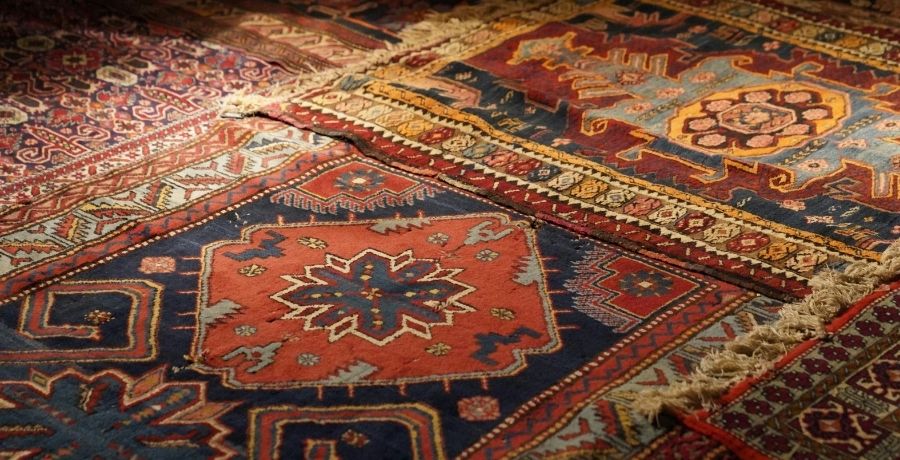
As someone who is surrounded by the art of Persian weaving and works with Persian rugs here in Sydney, I have always been fascinated by the fact that each rug has its own story. The heritage of Persian rugs is overwhelmingly rich, full of symbolism and local identity as well as centuries of craftsmanship. Each weaving hub in Iran has developed its own distinctive style, and the knowledge of these details is one of the greatest pleasures of my work.
Abadeh is among the numerous weaving regions that occupy a special place. When individuals are looking for various City Rugs, Abadeh always shine through, as they have the power of tribal design and the sophistication of urban Persian designs.
For clients and collectors who want their rugs to possess character, history, and enduring beauty, Abadeh pieces can become favourites. Their antiqueness, patina and cultural richness also render them very attractive among Antique Rugs.
Abadeh rugs do not merely exist in the world of Persian carpets as decorative items; they are also woven reflections of heritage, identity, and craftsmanship. And here in Sydney, they still appeal to homeowners, designers, and collectors who value authenticity and craftsmanship.
The Geographic and Cultural Roots of Abadeh
The history of Abadeh rugs is closely tied to the unique geography of the town. Abadeh was situated in a strategic position between the key Persian cultural capitals of Shiraz and Isfahan, and served as a crossroads where trade routes, artistic concepts, and weaving traditions converged.
This place played a decisive role in the creation of the Abadeh rug, which evolved into a distinctive style that combined the authenticity of the tribes with the elegance of the city. This landscape is crucial for understanding and appreciating the comprehensive historical context of the Abadeh rugs and their rich design heritage.
Influence of Nomadic Qashqai Tribes
One of the major elements of Abadeh weaving history is the Qashqai tribes, who were nomadic and traversed the area over generations. Their daring geometrical patterns, symbolic animal figures, and vivid colour backgrounds were the initial backdrop of what was to become known as the traditional Abadeh rug’s history.
The weaving traditions in other nomadic cultures are also naturally in line with these tribal influences. When discussing the daring geometrical artisanship of the early days of Abadeh, you may refer to Afghan Rugs as a counterpart to highlight the more general nomadic weaving analogies.
The Evolution of the Abadeh Style
As Abadeh grew into an active commercial centre, the designs of the rugs started to change towards more urbanised and sophisticated patterns. It marks the beginning of the evolution of Abadeh rugs, as Qashqai influences were combined with the elegant artistic taste of the neighbouring urban weaving centres. It is a hybrid style that reflects the Abadeh rugs’ heritage: a peculiar blending of nomadic spontaneity and the weaver’s urban accuracy.
This development reflects the regional design influences. When discussing motifs and structures influenced by neighbouring cultures, Turkish Rugs are related in terms of their Anatolian geometrical echoes. In contrast, Pakistani Rugs and Indian Rugs can serve as more general examples of regional weaving traditions that share some technical or stylistic connections.
A Cultural Convergence that Defines Abadeh
In general, the origin of Abadeh rugs could be regarded as a cultural fusion: the art of tribal Qashqai weaving conflicts with the finer art of weaving in Persian cities. It is this mixture that gives the Abadeh rug-making traditions their central core, making the history of Persian Abadeh carpets not only multidimensional but also deeply rooted at the border of geography and culture.

The Development of the Abadeh Weaving Style
The development of the Abadeh weaving style is a fascinating artistic evolution closely tied to the history of Abadeh rugs. What started as an entirely tribal craft gradually evolved into one of the most familiar urban-driven weaving traditions in Iran.
This stylistic development constitutes a significant stage in the history of the Abadeh rug, and it demonstrates how functionality, symbolism, and cultural exchange predetermined the evolution of Abadeh rug-making traditions throughout history.
From Simple Tribal Designs to Refined City Patterns
At an earlier period, the origin of the Abadeh rugs was traced to the simple but rich designs of the Qashqai tribes. These structures featured massive angular shapes and symbolic figures related to nomadic identity. With Abadeh increasingly linked to larger Iranian cities, however, there was an introduction of more detailed, structured compositions and balanced layouts, indicating the transition from rural craftsmanship to a commercially based urban style.
This change is an element in the evolution of Abadeh rugs, in which the heritage of Abadeh rugs meets the power of the tribes with the sophistication of the urban weaver. It also sheds light on the origins of Abadeh rug craftsmanship, where historical aspects became increasingly exquisite due to the adoption of new artistic norms.
Medallions, Geometric Borders & Animal Motifs
As Abadeh’s design matured, central medallions, framed geometrical borders, and stylised figures of animals became hallmarks of the design. These elements make the Abadeh rug’s origin rich, as they relate to the tribal symbolic motifs and the balanced discipline of urban Persian carpet design. The resulting motifs are now readily understood as belonging to the history of Persian Abadeh rugs, a combination of sentiment, narrative, and technological craft.
This fusion of tribal and urban influences is also related to the broader historical context of Abadeh rugs, as the art’s identity developed continuously without abandoning its roots.
Vegetable Dyes and High-Quality Wool
Real Abadeh pieces are praised for their artistry in natural vegetable colouring and high-strength wool. These natural hues result in warm reds, deep blues, and earthy tones that wear well and help augment the timeless nature of the Abadeh rugs’ heritage.
Vegetable Dye Rugs is also focused on the purity of colour, craft dyeing, and cultural continuity.
As you compare and contrast traditional materials with new techniques, however, you can pave the way to Modern Rugs– a point of connection when you compare synthetic dyes, machine-aided weaving or minimalist designs with the traditional technique of the Abadeh.
The Style That Defines Abadeh Today
All these events contribute to the history of Persian Abadeh carpets, which is why collectors and enthusiasts so highly regard the origin of Persian Abadeh rugs. The transformation of tribal spontaneity into urban sophistication highlights the traditional Abadeh rugs’ history, which made each object a living thing in terms of the transformation of weaving in this region.
Craftsmanship and Materials Used in Abadeh Rugs
The history of Abadeh rugs cannot be complete without discussing the extraordinary work and the specially selected materials used to characterise them. The technical accuracy of the weavings is one of the primary factors in the history of the Abadeh rug, reflecting centuries of perfected art in the region. Such a quality focus has been a persistent influence on the origin of Abadeh rug history, and it explains why they have become so popular among collectors and enthusiasts.
Weaving Techniques: Asymmetrical Knots & Dense Construction
Another technique that traditional Abadeh artisans use, which is an integral part of Abadeh weaving history, is the asymmetrical Persian knot. It is a knotting technique coupled with a remarkably thick weave that makes the carpets remarkably strong and clear in design.
The artistry of these weaving styles is also an important factor in the historical background of Abadeh rugs, showing how the region incorporated both tribal and urban standards of weaving.
It is this precision and artistry that can frequently be showcased in a superior piece of art that can be rightfully compared with curated Masterpieces– an opportunity for perfect connection when demonstrating a high level of craftsmanship.
Wool Quality, Colour Palette & Silk Accents
The use of high-quality wool, which is soft, strong, and capable of absorbing dyes, is the foundation of the origin of Abadeh rugs. The colour scheme, the construction based on rich blues, warm reds, and natural neutrals, is a sign of authenticity. The colours are usually obtained using natural vegetable dyes, which help preserve the organic colour.
In other finer ones, the addition of fine silk highlights to emphasise motifs or borders is made by the artisans. This graceful touch represents the sophisticated aspects of the origin of Abadeh rugs. Regarding such lavish specifics, Silk Rugs also utilise the same shiny materials.
A Testament to Abadeh’s Evolving Artistry
The combination of superior wool, skillfully chosen dyes, perfect mastery of knotting, and silk decoration in some cases allowed Abadeh weavers to create a unique style that remains distinctive today. These material decisions and methods demonstrate the evolution of Abadeh rugs, preserving authenticity while incorporating innovation.
Design Elements and Symbolism in Abadeh Rugs
The design identity of Abadeh rugs is an elegant blend of tribal symbolism and urban Persian style. Every motif, colour, and element of the structure narrates the origin of the Abadeh rug. These design aspects evolved, preserving centuries of art while shaping the present understanding of the art.
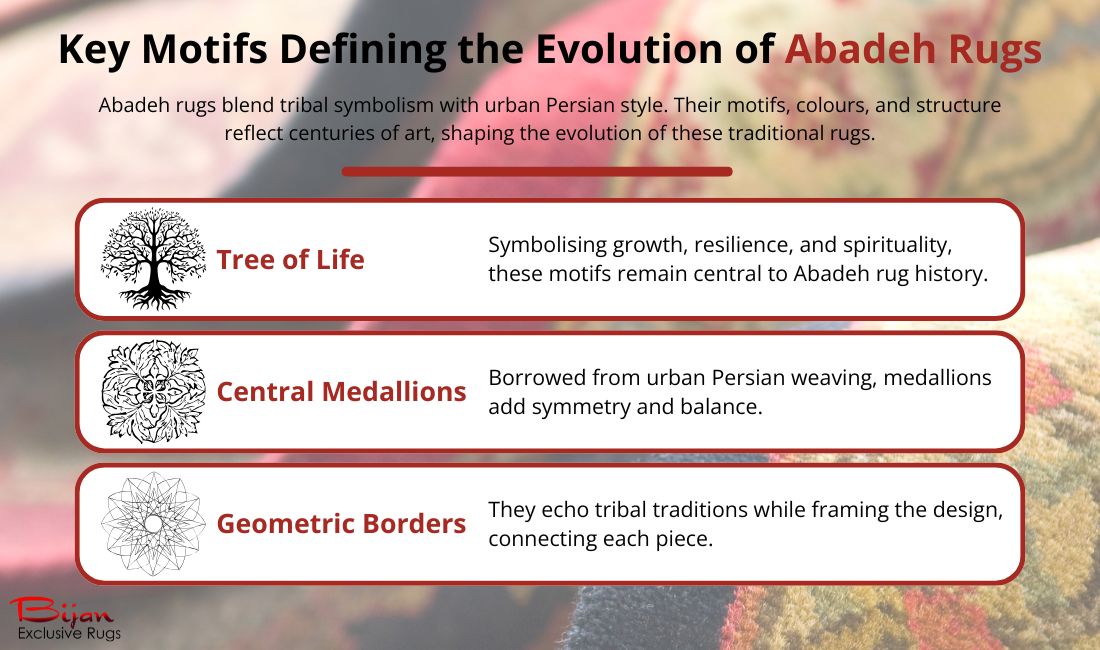
At the heart of the traditional Abadeh rugs’ history are the key motifs that have defined the evolution of Abadeh rugs:
- Tree of Life motifs – Representing growth, resilience, and spirituality, these symbols remain central to the history of the Abadeh rug.
- Central medallions – Borrowed from urban Persian weaving centres, medallions introduce symmetry and balance, reflecting the transitional phase in the origins of Abadeh rug craftsmanship.
- Geometric borders – Echo tribal traditions while framing the rug’s design, linking the work to the historical background of Abadeh rugs.
These timeless themes render Abadeh carpets as natural vintage rugs; their classic design still attracts admirers and fans.
Colour also plays a crucial role in expressing the origin of Persian Abadeh rugs:
- Deep reds – Signifying vitality and protection.
- Rich blues – Conveying spiritual depth.
- Earthy neutrals – Representing harmony and balance.
These exquisitely chosen colours, which are normally achieved through natural dyeing techniques, add strength to the Abadeh rugs’ heritage.
Additionally, in terms of colour, the symbolic shapes and patterns, including diamonds, stars, angular tribal, and stylised animal figures, represent harmony and mythical narratives of cultures.
Such a strange fusion of tribal expressiveness and urban weaving accuracy makes Abadeh rugs a timeless hybrid of beauty.
Abadeh Rugs in the Modern Era
Abadeh rugs do not stop their story in the past; they continue to evolve in the modern era. The Abadeh carpets are more popular in international markets today due to their creativity, quality, and cultural significance. They are unique not only to collectors and fans, but also as reminders of the Abadeh rugs’ heritage.
Global Market Presence and Collectability
Abadeh rugs have gained a leading role among Persian carpets nowadays. Their fusion of tribal themes, urban elements, and skilled craftsmanship makes them not only desirable decorative items but also good investments.
Key factors contributing to their collectability include:
- Unique motifs and patterns – Maintaining the essence of the traditional Abadeh rugs’ history.
- Material quality – Dense knotting, high-quality wool, and occasional silk highlights underscore the Abadeh rug’s craftsmanship origins.
- Provenance and age – Older rugs demonstrate the evolution of Abadeh rugs, making them especially prized in collector circles.
Integration in Modern Interiors
Abadeh rugs are not confined to museums or antique collections; they have been warmly welcomed into modern homes. Their minimalist designs can be used to match any style of interior, whether traditional Persian-inspired or minimalist. Specifically, they are used in useful schemes like:
- Runner Rugs – Perfect for hallways or narrow spaces, showcasing Abadeh patterns.
- Oversized Rugs, Square Rugs, and Round & Oval Rugs – Offering flexible options for living rooms, dining areas, or bedrooms.
For homeowners and designers who want to get a visual feel for how an Abadeh would look before purchasing one, our Rug Visualiser offers an interactive experience that allows you to visualise how these rugs would fit into various spaces, colours, and furniture layouts.
Why Collectors and Designers Value Abadeh Rugs
The Abadeh rugs hold a special place in both traditional and contemporary interiors, which can be attributed to their artistry, representing centuries of cultural expression. Their attractiveness lies in the flawless combination of all elements of beauty, craftsmanship, and heritage, which are built upon the history of Abadeh rugs.
Their preservation by collectors and designers has made them especially valuable, as they continue to carry forward the history of the Abadeh carpet, while also being versatile enough to fit current design trends.
Balance of Durability, Artistry & History
The most distinctive feature of Abadeh rugs is that they can be both strong and artistic. This contrast is a characteristic component of the Abadeh rugs’ heritage. Their rich weaving, fine wool, and well-designed patterns reveal their historical background, and their designs and colours continue the visual narrative of the Persian Abadeh rugs’ history.
Collectors appreciate them for:
- Durability – Dense knotting and high-quality materials ensure a long lifespan.
- Artistic integrity – Motifs rooted in both tribal and urban influences express the historical background of Abadeh rugs.
- Cultural value – Each rug represents a chapter in the evolution of Abadeh rugs, carrying forward generations of tradition.
How to Identify Authentic Abadeh Rugs
Determining the authenticity of an original Abadeh rug requires an understanding of the factors associated with the production of Persian Abadeh rugs and the attention to detail involved in Abadeh rug-making traditions. Original works are often associated with specific details that reflect the background and artisanship of the region.
Key identifiers include:
- Asymmetrical Persian knots – A signature of traditional weaving methods.
- Balanced medallion or geometric layout – Consistent with classic Abadeh structure.
- Warm, natural dye palette – Deep reds, blues, and earth tones aligned with the Abadeh rug history.
- High-quality wool with occasional silk highlights – Indicating refined craftsmanship.
Find a Rug that Resonates With You!
Abadeh rugs are not mere decorations, but rather cultural and artistic manifestations that are knotted in each single knot. Their heritage continues to live on in the present houses, and their endless beauty ensures they stand the test of time and remain relevant even today.
At Bijan Exclusive Rugs, we take pride in offering one of the most diverse collections of high-quality Persian rugs in Australia. You can find the right rug in our collection of classics, modern, and one-of-a-kind pieces. All rugs are chosen with the same love of craftsmanship and authenticity that has influenced my lifelong attachment to Persian weaving.
When you are ready to find a rug that resonates with you, visit our collection. Your perfect piece is waiting—and I’d love to help you find it. Contact us now!