

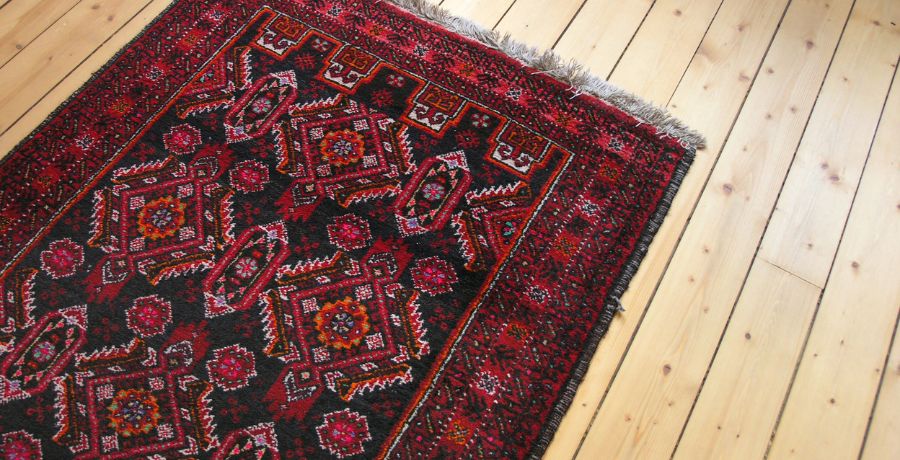
Having worked with Persian rugs in Sydney for years, choosing the perfect rug size is among the strongest methods of transforming a house. The correct rug sizing and rug placement do not simply just fill up a floor, but they also make a room look lavish, balanced and welcoming.
Persian rugs, with their intricate patterns and centuries of artistic tradition, are worthy of proper care and treatment. I have assisted Australian families in selecting rugs for their rooms, from bedroom rugs and rugs under beds to entryway rugs and hallway runners.
I will walk you through standard rug sizes in cm and demonstrate how you can place your rug in relation to your furniture to come up with the best rug layout.
At the end, you will know the perfect Persian rug size that fits every space of your home like a seasoned designer.

Living Room Rug Size Guide
The living room is the centre stage of your house – and the right Persian rug size grounds your sitting space, gives cosiness, and ties together your decorations.
The larger the better when it comes to living room rug size. An overly small rug will be “floating” in front of your couch, but a large-sized rug will make the place seem bigger and more united.
Designers recommend that you make at least the front legs of your sofas and chairs covered with the rug. The following are some of the important sizing tips and location suggestions for living room carpets:
Common Rug Sizes (Living Room)
Standard rectangular rug sizes in Australia for living areas include:
- 160 x 230 cm (5’x7’)
- 200 x 300 cm (6’x9’)
- 240 x 340 cm (8’x11’)
- 300 x 400 cm (10’x13’) or larger
These are common rug sizes and can fit with the international standard rug measurements. The size of a carpet that will suit most Australian living rooms is 240 x 340 cm, giving the area sufficient space to cover a 3-seater sofa and coffee table.
The single larger spaces or several to three sofas can need 300 x 400 cm or Oversized rugs to appear truly majestic.
Furniture Placement
There are three classic layout options:
- (1) All furniture legs on the rug
- (2) Front legs on, back legs off
- (3) No furniture legs on the rug (floating).
Option 1 gives a luxurious, cosy impression, best paired with a large rug that can accommodate an entire sofa and chair set.

Option 1: All furniture legs on a large rug (ideal for 300x400cm+).
The most common option is 2 (front legs on), which works well with medium-sized rugs, as it allows the sitting area to be anchored without overwhelming the surrounding room.

Option 2: Front legs on the rug (common for ~240x340cm rugs).
The Option 3 (no legs on) can be used only with small rugs or narrow areas, such as a small rug just below the coffee table, as this option can cause a room to look unbalanced if the sizing is poor.
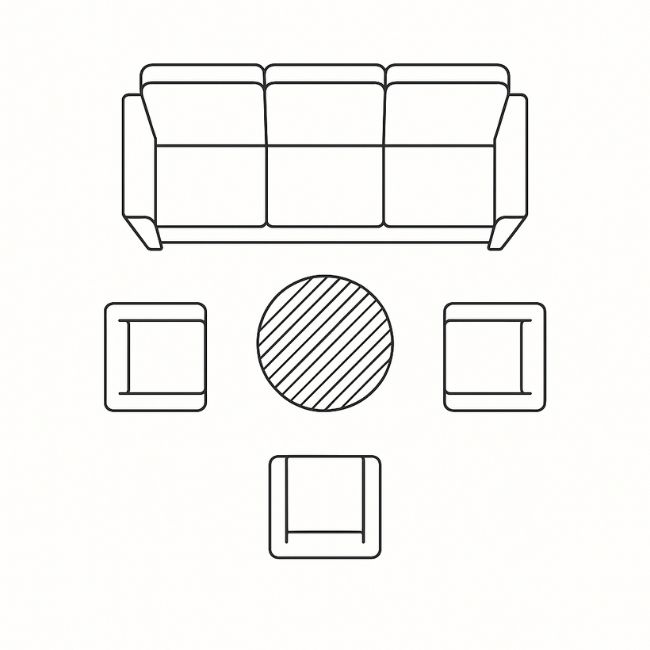
Option 3: Rug as an accent, no furniture legs on it (works for small rugs).
Regardless of the approach, consistency is key: try to have all seating pieces follow the same rule so that the arrangement looks intentional.
Either way, it should be consistent: attempt to make all the seat elements follow the same rule so it looks intentional.
Leave a Border
Carpeting the whole room is unnecessary, but a rug must be used as an island that outlines the conversation area. Leave a border of bare floor around the rug to “frame” it. The room should ideally have 30–45 cm of visible floor at the edges.
A little less is permissible in smaller rooms. At least spare some space of about 20 cm so that the rug does not cling to the walls.
Persian Rug Sizing Examples
- Small apartment living room (2-seater loveseat and chair): a 160 x 230 cm rug might suffice with front furniture legs on the rug.
- A typical family living room (3–4 seater sofa and armchairs): 240 x 340 cm, allowing at least the front legs to sit on the rug.
- Expansive living rooms or open-plan layouts: 300 x 400 cm and beyond – consider big rug sizes or oversized carpet to cover large lounge areas.
In case of doubt, opt for the larger rug size (as long as you have a floor border). A too-small rug is the most common error and makes the room look poorly proportioned.
Our Oversized Rugs are available in sizes that can cover big lounge areas.
Visualise your living room. Try our free Rug Visualiser tool! Upload a photo of your living room and see any Bijan rug (in any size) virtually on your floor, scaled to fit. Give it a go and watch your living room come to life!

Bedroom Persian Rug Size Guide
A bedroom rug keeps the feet warm and gives the room a hint of classiness. It is placed to frame the bed with the rug to form a soft border when you get out of bed.
You will want to make sure you select the appropriate rug size to prevent overwhelming the space. The following are the best considerations:
Coverage Around Bed
One of the rules is to make sure that there is at least 60 cm of the rug that goes beyond the sides and foot of the bed to create a balanced appearance.
What size rug for a queen-size bed? For a Queen bed (approx. 153 x 203 cm mattress), the queen bed rug size should be at least 240 x 340 cm. It will work wonderfully under a queen bed, offering about 45 cm on each side and ample length at the foot.
A King bed (183 x 203 cm mattress or larger) is sized up to a 300 x 400 cm rug unless a larger size is available. This fits common king-size bed rug dimensions and will leave about 60 cm of border on all three sides of the bed.
At the very least, rug size under king bed you’d want a 270 x 360 cm (9’x12’) to avoid the rug looking too small.
Tip: Ensure the rug width is greater than the bed width (including nightstands if they flank the bed). You never want the rug ending narrower than the bed or just at the bed’s edges – it should extend beyond for a proportional frame.

Alternate Layouts
In smaller bedrooms or if you already have carpet, you can opt for side runners or smaller accent rugs instead of one large rug. One approach is placing two runners on each side of the bed (e.g. 70-80 cm x 200-250 cm runners), which gives a soft landing on each side.

Another option is a single rug at the foot of the bed (not under it at all, but in front of it) – for example, a 160 x 230 cm decorative rug laid perpendicular to the bed, covering the floor at the foot area.
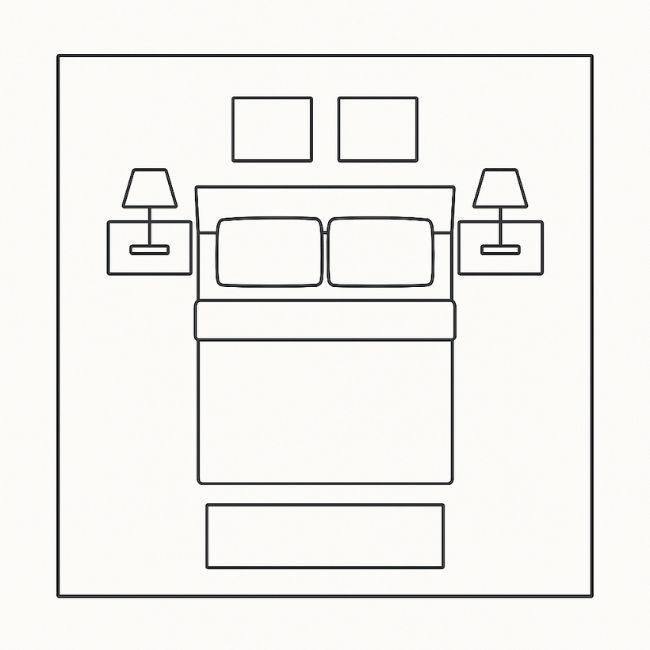
Just ensure any rug at the foot is wider than the bed width and is centred for symmetry.
Browse our Persian Rugs collection to find the perfect style and rug size for your bedroom. From serene Kashan floral designs in calming blues to bold Tribal geometrics for boho bedrooms, there’s a Persian rug to suit every décor.
Use our Rug Visualiser to try different rugs under your bed virtually – see how various colours and patterns complement your linens and wall colours before you commit!
Dining Room Persian Rug Size Guide
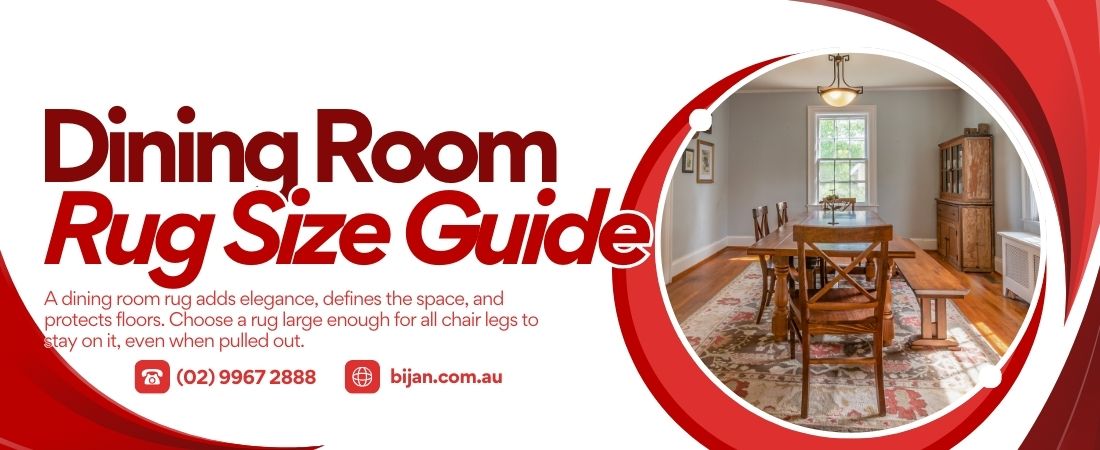
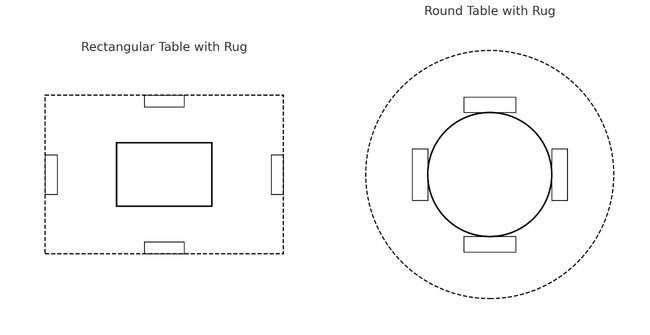
A rug in a dining room not only gives your space a sense of definition and elegance, but also covers your floor against chair scuffs. The first and foremost rule when it comes to selecting a dining room rug size is always to make sure that the rug is big enough to ensure that all legs of the chairs remain on it, even when the chairs are pushed away.
You will need to have a 60-75 cm rug that extends beyond the table along all sides. This is so that when a person moves their chair back, the legs stay on the carpet.
Sizing by Table Size/Capacity
Here are some guidelines for common dining table sizes and the rug dimensions that suit them:
4-Seater Dining Table
A standard rug size, which is approximately 2.0 x 2.5 m or 2.4 m round.
A 200 x 300 cm carpet can be used when a 120 cm round or a 1.2 x 0.8 m table is used. This will provide approximately 50 cm of added space on both sides, which is the minimum comfort zone. When there is space, even more room will be given to the pull-out, which will be 240 x 340 cm.
Tip: In case your dining table is circular, a circular rug of the appropriate Persian rug size would easily fit in and appear best.
6-Seater Dining Table
They tend to be 1.5-1.8m long (and about 90 cm wide). The size of an appropriate rug would be around 2.5 x 3.5 m.
A six-seater (240 x 340 cm) is a highly popular option, which is usually large enough to cover a table ranging 180 x 100 cm, plus ~80 cm on each side for chairs. Another option is a 250 cm round table for a large, 6-seater round table.
Never guess the size of your table when it has chairs that have been pulled out. When your chairs are out to, say, 320 cm in total length, you would want a rug to be at least 330-350 cm long to cover them comfortably.

8-Seater (or larger) Table
An oversized carpet solution will be required for a large dining table (2.1–2.4 m long or beyond). Aim for about 3.0 x 4.0 m or larger.
For example, a 300 x 400 cm rug can accommodate a lot of 8-seater tables (approximately 240 x 120 cm), as it is 60+ cm additional on both sides.
When you have a table of 10-12 seats or an extendable one, you may require a rug 350 x 450 cm or even a large customised rug size to be able to cover the entire surface.

Avoid “Skimpy” Rugs
A common mistake is using a rug that just barely fits under the table and chairs. If any chair legs fall off the rug when pulled out, the size of the rug is too small.
How big should a rug be? Always choose larger. If your room size is a limiting factor, consider a smaller table or no rug, rather than a tiny rug. Designers say it’s “better to go larger than risk a ‘skimpy’ look” in the dining room.
Check out our Persian Rug collection by size – filtered for larger sizes ideal for dining setups.
Whether you need a 3x4m Tabriz for your formal dining room or a durable Gabbeh for an eat-in kitchen, we have options.
And if you’re unsure, use our Rug Visualiser to place different rugs under your table before you buy virtually!
Hallway & Runner Persian Rug Size Guide
Runner rugs are very good in the hallways and corridors – they provide warmth, noise reduction, and direct the eye through your house. A bedroom rug or rug in a room can be used to change the space; however, in hallways, a runner rug will be in the spotlight.
Persian runner rugs, which are usually hand-knotted in long, narrow dimensions, can make a plain hallway into a hall of art. This is what to take into consideration in hallways, entrance corridors, and other tight spaces:
Runner Dimensions
Hallway runners generally range from standard rug sizes in cm of around 70 cm to 90 cm in width and any length between 200 cm and 600+ cm in length.
Choose a length that leaves some floor exposed at the ends of the hallway. One of the most widespread guidelines is to leave a certain amount of bare floor at the ends of the runner.
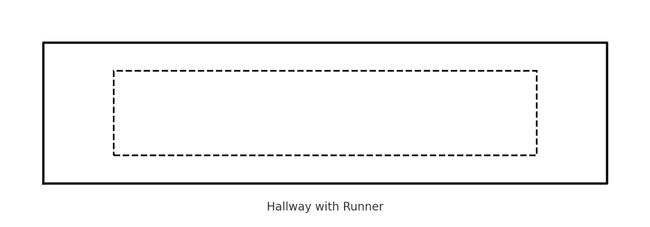
Likewise, leave a bit of floor showing on both sides of the runner so that it is not wall-to-wall. The runner is supposed to be in the middle of the corridor, and the distance should be equal on both sides.
Hallway Coverage
Aim to cover the walking route. In a hallway, you want both feet to land on the rug with each step. A runner that is too short and will not look like a runner.
When you have a very long hall, you can have a series of runners. In that instance, maintain a space between the two runners (15 cm or so).

In the case of using several runners, make sure they have the same pattern or are close so that they appear to be continuous.
Explore our curated Persian Runner Rugs collection for an array of hallway runners in various lengths.
You can have a 3-metre Tabriz runner or a 5-metre Afghan runner; we have it. Not only are these runners beautiful, but they are designed to withstand heavy traffic.
And in case you do not know what it will look like for your space, you can use the Rug Visualiser to add a photo of a hallway and virtually test out several runners.
Entryway & Foyer Persian Rug Size Guide
The first thing people will see in your house is your entrance. A perfect Persian rug can make guests marvel at the first sight of entering the house, just as a perfectly placed bedroom rug or a rug in a room does. The use of entryway rugs is also utilised in catching dirt and defining the foyer area.
Use these rug sizing and rug placement tips to choose the perfect piece.
Choosing Shape – Rectangular, Runner, or Round
You can have an entryway shaped in any way you like. In a long, narrow entry hall, a runner may be appropriate.
In a more square foyer or the entrance of a grand entry, a square rug or a round rug will appear spectacular, particularly when there is a pendant light or if it’s centred in the space.
Round rugs are likely to warm the appearance of sharp entry walls and are capable of echoing circular features. Actually, a round Persian carpet in a hall can make a lovely centre piece.
When the entrance is a plain rectangle, a regular rectangular carpet can also be used, though it has to be correspondingly sized.
Size Guidelines
Generally, in an open foyer, you would like the rug to cover the area broadly and at least 20–30 cm away from the walls or door floors. If the rug is too small (a doormat size), then it will be out of proportion.
Ensure free opening of doors over the rug. If the entry is a direct entry into a hallway or a room, the rug could be oriented (visually) to that direction or furniture.

- The dashed square is the rug, placed in the open area without touching the door or walls.
- A console table is against the top wall.
- A bench sits along the left side.
- A round accent table is in the center.
Rug Durability
Entries are trafficked and often soiled by dirty footwear. Fortunately, Persian carpets are up to the task. Wool fibres are, by nature, dirt-resistant, and patterns conceal signs of wear.
With that said, it is prudent to take certain precautions: place a shoe rack or a mat by the door so that the majority of the grit would be left outside the Persian rug.
Have the entry rug vacuumed regularly. Rotate it every year or so if one side gets more sunlight or wear. And if a major spill occurs, address it promptly – blot and clean as appropriate (our Persian Rug Cleaning Guide provides helpful tips).
A dark, busy pattern will come in handy (e.g., Afghan Khal Mohammadi rugs are great in entries for this reason).
Making a Statement
Remember that the entrance is a chance to impress. A nice Persian carpet sends the message of style and luxury to any passerby.
As Bijan Exclusive Rugs advises: “The foyer is your opportunity to make a fantastic first impression on the visitors. It should have a presence in this place.”
Use a unique one. An Antique Persian rug with aged patina for old-world charm, or a bold modern Persian rug to establish a new mood.
Either way, you want to make sure that whatever you pick, you like to look at it, as you are going to see it every day as you come home!
Visit our Round & Oval Rugs section if you’re considering an out-of-the-box round Persian rug in your foyer; it can definitely impress your visitors. There are also Vintage Persian rugs of smaller size, which will add some beauty to your entryway.
Experience the Bijan Difference!
Throughout years of dealing with Persian rugs, I can honestly say that when you put the right rug size in every room of your house, you are not just adding beauty and cosiness.
Naturally, these are not strict regulations. Priority will always be on your personal taste and practical needs.
Measure, visualise and find the right piece, and you will have interiors that are comfortable, luxurious, and welcoming.
Our rug specialists will always be happy to advise on the common rug dimensions and provide style ideas.
Experience the Bijan difference. We don’t just sell the rugs; we help you style them to perfection. We will assist you in selecting a rug that will be a lifetime favourite, and we will carry the true Persian luxury into your house.