

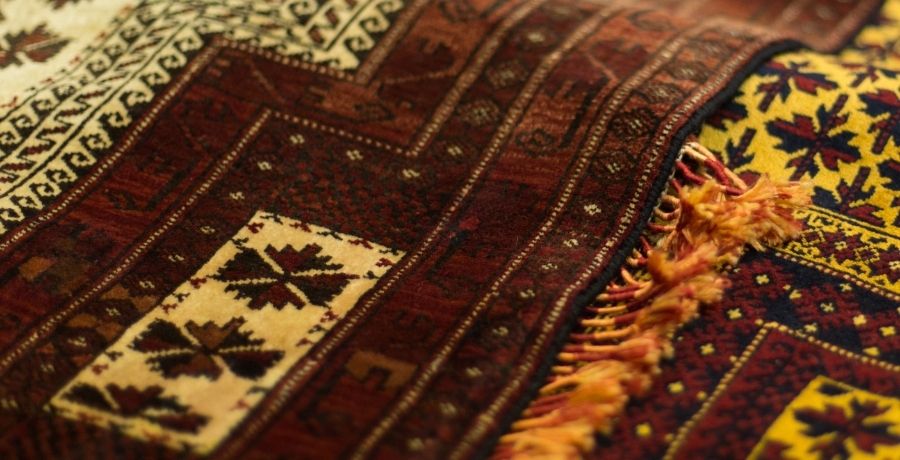
I have witnessed both experienced and first-time buyers fall in love with these masterpieces. The history of Jaipur carpets is a kind of a tapestry that has to be unloaded and retold. Each pattern and thread is a story.
In this engaging, yet informative guide, I will provide the history of Jaipur rugs, the way these carpets have evolved over the years and the workmanship that has made them so popular all over the world.
Origins of Jaipur Rugs in the Mughal Era
Jaipur rugs are a product of the Mughal Empire in India. The seeds of the Indian rug industry were successfully sown in the 16th century when the Mughal Emperor, Akbar invited the master carpet weavers of Persia to the court of the Emperor.
In such cities as Agra, Delhi, and Lahore, Persian craftsmen established royal workshops (karkhanas), where the local artisans could learn the secrets of the carpet weaving art. The Jaipur region artisans quickly adapted these Persian methods and translated them to suit their own creativity, and the local style of rug weaving was created.
To put it another way, the origin of Jaipur rugs can be said to be a win-win cross-cultural dialogue: Persian city rugs aesthetics and Indian artistic sensibilities, creating something unique.
By the 17th century, Jaipur (now capital of Rajasthan) had become a fledgling center of rug weaving influenced by the Mughals. The rulers of the region Maharajas of Jaipur were great patrons of arts.
The history of Jaipur rugs in this era is closely connected with the court orders; the palaces, courts, and great temples were decked with carpets, which were usually unique to demonstrate the level of wealth and power.
Royal Patronage and Artistic Evolution
The carpet craftsmen of Jaipur had a style that was developed with encouragement of the royals and had a mixture of imported Persian motifs with Indian motifs and colours. Gradually, Jaipur carpets developed the design elements that were well balanced in terms of both design and use.
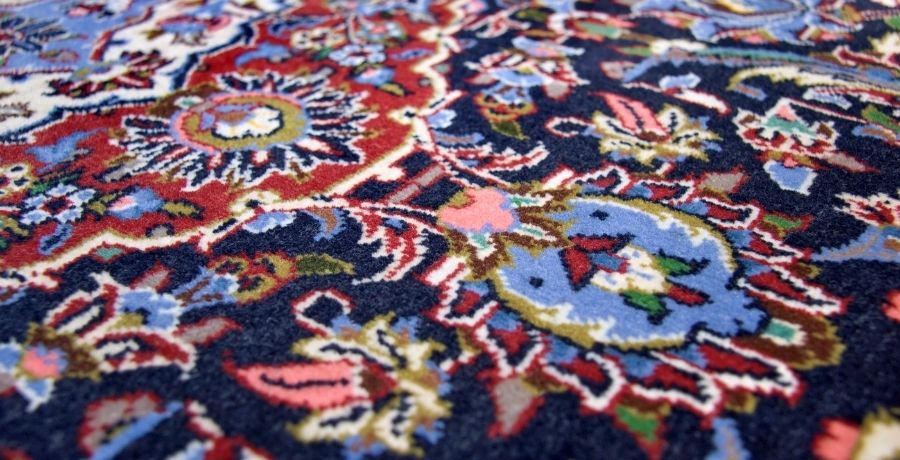
A local interpretation of the traditional Persian patterns created nuanced versions that were both familiar and novel. Colours were very bright and were based on India’s natural palette: dark indigo blues, deep madder reds, golden turmeric yellows, and others.
Natural vegetable dyes such as indigo, pomegranate and turmeric are what’s used by weavers to obtain these luxurious colours. These dyes not only give rich colours, but they also fade beautifully to a mellow, organic beauty on the antique pieces.
Jaipur carpets had gained a reputation in the 18th century because of their superior artistry. They were all hand-knotted, with a fine detail being made possible by using the asymmetrical Persian knot (a technique brought by the Mughal weavers).
Some of these early Jaipur carpets were literal masterpieces of the art of textiles, and were the envy of nobles. As a matter of fact, most of the antique rugs today in the City Palace Museum in Jaipur and numerous Mughal carpets represent this period of golden age in design.
The royalty of India was not the only one who appreciated the rugs of Jaipur. The fame of Jaipur carpets spread and they became in demand way beyond Rajasthan.
The combination of Persian beauty with Indian style made the Jaipur weavers produce the rugs that were attractive to the foreigners. Fine Jaipur carpets were a common treasure among the European visitors and traders in the eighteenth and nineteenth centuries.
Jaipur rugs in a sense became the symbol of Indian rugs in the global arena – the symbol of luxury, artisanship, and blending of cultures.
The Colonial Era and the Jaipur Jail Carpets
Carpet weaving in Jaipur, as was the case with many other traditional arts, was troubled by the colonial period (19th century). The migration of cheaper industrial products and the transfer of patronage due to British rule caused the weakening of some local crafts.
But, a peculiar turn of history saw the Jaipur heritage of rug making survive. Around the middle of the nineteenth century, a program of rehabilitating prisoners in Jaipur that was launched by Maharaja Sawai Ram Singh II transformed inmates in jails into weavers, reviving the craft.
In 1854, he set up carpet workshops in Jaipur Central Jail where inmates were taught to hand-knot rugs. Soon, Jaipur carpets became known as jail carpets in the world due to their quality and it also helped the weaving art get a second lifeline.
These carpets woven by convicts became a sort of art conservation, even being exhibited in the most prestigious exhibitions. The jail carpets of Jaipur were exhibited in international gatherings like the great exhibition of 1851 in London where their elaborate designs and fine workmanship amazed the visitors.
Post-Independence Revival and Global Reach
The rug industry in Jaipur had a new beginning when India became independent in 1947. The local businessmen and craftsmen labored to modernise the trade without violating the tradition as they were freed of the colonial restrictions. Jaipur grew to be a big carpet trade hub, which had a greater export market that sought the use of genuine hand-knotted carpets.
In the middle of the 20th century, the Western market was becoming increasingly interested in oriental carpets, and Jaipur with its history of high-quality weaving was set to take advantage of the occasion. Weaving families which had preserved the craft alive (some even dating back to those prison workshops or royal karkhanas) found global appreciation for their work.
Some of the family-owned businesses and cooperatives in Rajasthan also made efforts in the late 20th century to bridge the gap between the weavers in Jaipur and foreign markets.
These activities did not only increase the coverage of Jaipur rugs but it also empowered thousands of artisans, some of whom were women living in rural villages, by giving them sustainable livelihoods.
Jaipur is now a city that boasts of being the hub of the Indian rug industry, a 2,500-year old tradition with modern innovation. This is done with workshop looms vibrating around Jaipur and all of the neighboring towns, as the craftsmen, many of whom are descendants of the weavers who first started this craft way back in the Mughal days, still apply the painstaking technique of hand-knotting.
They manufacture a spectacular collection of rugs to meet different preferences. On one hand, it is possible to find traditional patterns that are oriented to the Persian gardens or Mughal palaces and, on the other hand, there are advanced modern rugs with abstract patterns or minimalistic patterns that suit the latest interior design trends. This adjustment between the old and the new makes Jaipur rugs topical in the 21st century.
Regardless of whether it is a large silk rug commissioned in a five-star hotel or a simple woolen carpet designed in the family living room, every item that is produced in Jaipur nowadays bears the label of generations of experience.
Artistry and Craftsmanship: What Makes Jaipur Rugs Special
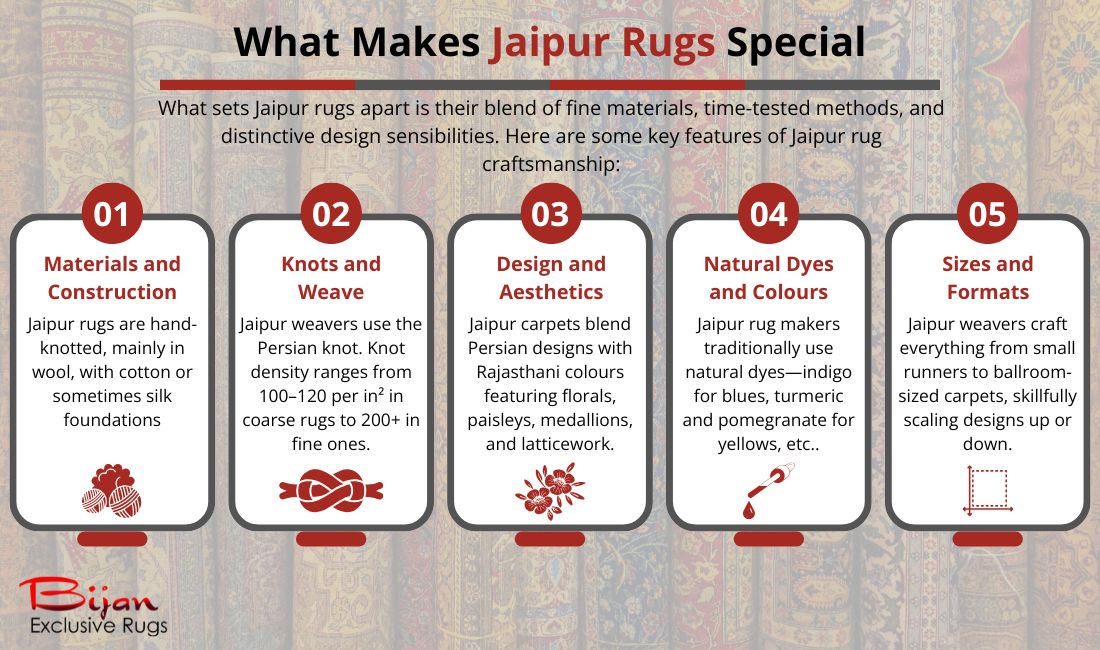
The question may be: what really makes Jaipur rugs stand out of all other Indian rugs or Persian carpets? The secret to this is in a mix of the fine materials, well-tested methods, and unique design sensibilities. Here are some key features of Jaipur rug craftsmanship:
- Materials and Construction: Jaipur rugs are mostly hand-knotted with a high quality of wool as the major fiber used. In most cases weavers apply a cotton foundation (warp and weft threads), but occasionally weavers apply silk as the foundation of extremely fine rugs. These rugs are completely handmade on the loom (usually months to make a single carpet, no matter what material is used).
- Knots and Weave: Weavers in Jaipur still use the Persian knot (also known as asymmetric knot) method, which is a remnant of the Mughal-Persian influence. Depending on the fineness, the number of knots per inch (knot density) may be 100-120 knots/in 2 or less on a coarse rug and 200 or more on a very fine Jaipur rug. The art and patience needed here are enormous: the weaver of a particular piece will work off thousands of knots in one day, or develop the design line by line.
- Design and Aesthetics: A distinctive feature of Jaipur carpets is the combination of the Persian style of the design and Rajasthani colour accent. There are scrolling floral patterns (lotus blossoms, vines, paisleys), geometrical trellis or latticework and central medallions and elaborate borders overgrown with blossoms and leaves. These are distinct echoes of traditional Persian carpets, but Jaipur carpets in modern use tend to have more colour schemes and distinct touches and inclinations.
- Natural Dyes and Colours: Conventionally, Jaipur rug manufacturers have been good at dyeing yarn using natural dyes. The leaves of indigo generate deep blues, madder roots generate reds and pinks, turmeric and pomegranate skins generate yellows and golds, and iron or walnut may be used to obtain soft blacks and browns. Currently, although modern synthetic dyes are sometimes used in some workshops to achieve some colours, there has been a vast trend (particularly by high-end manufacturers and by historic brands) to keep using these centuries-old methods of dyeing.
- Sizes and Formats: Jaipur weavers are flexible in terms of size they make. They make small runners to fit in halls, more standard room-sized area carpet, all the way to oversized carpets, which can be used to cover a ballroom. This variety implies that someone may require a tiny runner to fit into a corridor or a large statement carpet to suit a great room. The art of weaving that is remarkable in such weavers is the capacity to increase or reduce the magnitude of a design without degrading harmony.
All this, the great materials, great knots, artistic designs as well as rich colouring of the Jaipur rug, makes every rug a piece of art. When you have a Jaipur rug in your house, you have in your possession a fragment of a living tradition, which has been handled by masters.
Legacy and Collectibility: From Antique Masterpieces to Modern Treasures
Learning the history of Jaipur rugs would be an added advantage in enjoying these carpets in a collection or a home. Among collectors, older Jaipur rugs (particularly those of the 19 th -early 20 th century) are much sought-after antique rugs.
This kind of piece is becoming rarer with very high prices being paid at auctions, especially when they are documented or provenanced. As it was mentioned above, even the carpets of the jailhouse, which have traditionally been regarded as utilitarian products of a prison, are today regarded as vintage carpets that are collectible and priced at a premium and displayed in museums. That said, you do not need to be an aristocrat or museum curator to appreciate Jaipur carpets.
Most contemporary works are personalised giving the designers and homeowners an opportunity to add a small amount of personal narrative to the conventional structure.
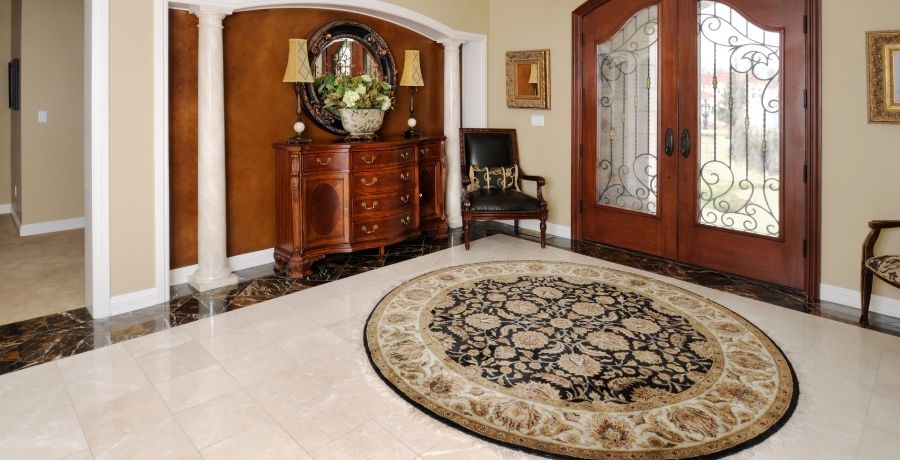
The outcome is a rug that would perfectly fit in a sleek urban living room but has the spirit of a typical oriental carpet. These Jaipur modern rugs are also becoming appreciated by the collectors, particularly those produced by well known trusted workshops that have high quality.
There is a Rug Suitable for Your Home
To conclude, Jaipur rugs have history and origin that demonstrates how a craft can be eternal yet at the same time be constantly developing. The history of Jaipur rugs is full of art, culture and people.
Decades of assisting Sydneysiders to find the ideal Persian and Jaipur rugs have made me look at how these rugs have touched the hearts of people of all social classes. You may be a layman, or an expert collector; Jaipur rugs will bring something very individual to you: a physical connection to centuries of beauty and heritage.
We have a huge assortment of designs, sizes, and stories at Bijan so whatever design, size, or story you are seeking, we can guide you to get what you exactly desire. There is a rug here suitable to be a part of the story of your home.
See or contact us now! Allow Bijan to show you the right rug.