

After years of experience in working with tribal and Persian rugs in Sydney, I have witnessed myself the scarcity of different traditions that can impress people as much as the Qashqai weaving does.
Their radical geometry, luxurious colours, and unquestionable handwoven quality make them one of the most expressive in the Persian tribal art.
Nowadays, when customers visit a single piece or browse through the larger rug collection, Qashqai rugs can always be identified by their authenticity and cultural richness.
They connect the gap between art and history and lived experience- and it is this that makes them still so significant in both traditional collections and contemporary interiors here in Australia.
Here’s what you have know about the history and origin of Qashqai rugs.
➜ Related: History and Origin of Baluchi Rugs
Who Are the Qashqai?
The Qashqai is a tribal confederation of Turks, who have long inhabited the southwest of Iran (primarily the Fars region). This seasonal lifestyle and societal set-up of the confederation is what the history of Qashqai rugs are all about.
As a result of Qashqai people being nomadic or semi-nomadic, their weaving practices were developed to be portable, useful, and narrative – creating pile carpets, saddlebags and flatweaves with a great deal of symbolic patterns.
The Qashqai tribal rug history reveals that there was a high tendency towards strong wool of durable texture, the use of hand-spun yarns, and the use of local plants in the dyeing process; these pragmatic decisions over the years became the aesthetic features of the history and origin of Qashqai rugs.
Current motif analysis and comparative research prove that there are regular semiotic themes in Qashqai kilims and pile rugs, and how the cultural beliefs and migration contacts influenced their visual language.
The Origins of Qashqai Rug Weaving
The origins of Qashqai rug weaving is heavily connected to the nomadic and tribal cultures of the Qashqai people that incorporates multiple centuries of migration culture with local textile culture of southwest Iran.
Knowing when and how Qashkai weaving originated allows locating the history and origin of Qashqai rugs in a wider context of Persian and Central Asian development of textile production.
When and How Qashqai Weaving Began
Historians of textiles date the introduction of Qashqai weaving at least to the early modern period, and tribal sources and ethnography suggest that the Qashqai had already learned the art of rug and kilim weaving by the 16th-17th century.
Weaving was a daily and migratory craft as well as a visual means of tribal identity since pastoral nomads practiced weaving as an element of daily life. The Qashqai weaving history can be followed to have a utilitarian origin, which evolved slowly to become an exclusive beauty that is being admired by collectors nowadays.
Historical Influences from Persian, Turkish, and Tribal Traditions
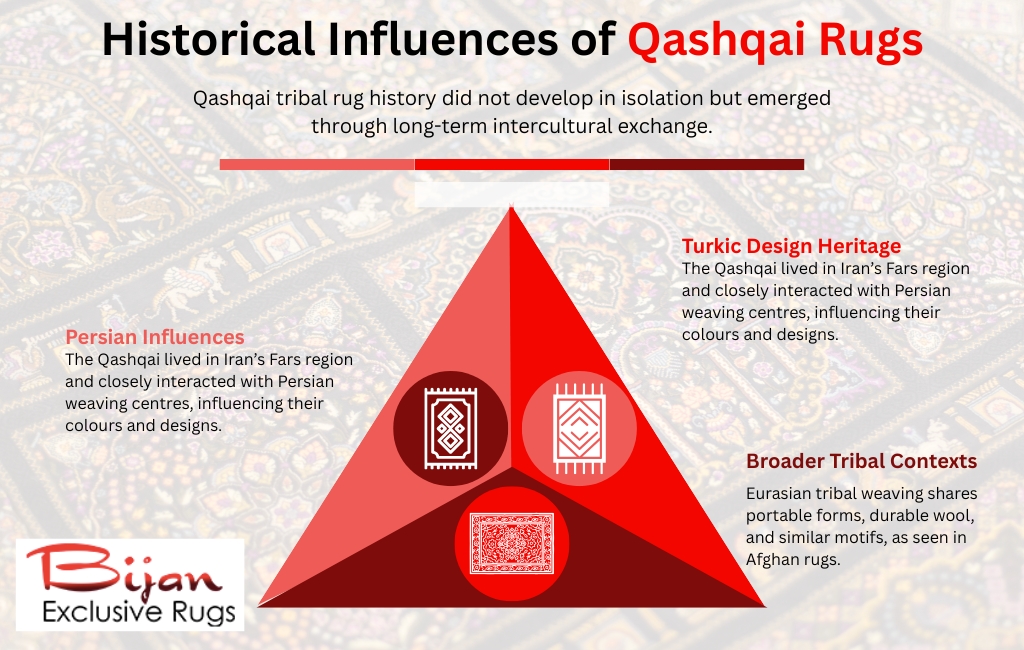
The Qashqai tribal rug history does not stand on its own two feet – the product was a product of intercultural exchange over the years:
Persian Influences:
- The Qashqai were located in the Fars region of Iran and were in close contact with the Persian urban weaving centres. Qashqai compositions were usually filled with Persian colour palette and other symbols of design making them look alike.
Turkic Design Heritage:
- The Qashqai have strong connections, linguistically and culturally, with the Turkic nomadic peoples. Certain patterns of Qashqai carpets resemble overall patterns in Turkish rugs, especially in geometrical structuring and rhythmical repetition of tribal patterns.
Broader Tribal Contexts:
- Eurasian tribal weaving has functional commonalities: portable mules, tough wool, and expressive iconographic systems. As an example, consider the comparisons with Afghan Rugs that reveal similarities in vocabulary of motifs and regional dye sources and similarities in cultural roots in tribal textile production.
The combination of these overlapping factors can be used to understand the way that the Qashqai rug history evolved to become an identifiable and valuable school of Persian tribal weaving.
Traditional Materials and Techniques
The fact that the materials and techniques of Qashqai rugs are closely connected to the environment and the life of the Qashqai people are one of the most intriguing facts about the history and origin of Qashqai rugs.
The historical background of Qashqai rugs is the trace of the tradition that was formed by the necessity to provide practical and daily demands with the rich artistic language.
Natural Wool and Hand-Spun Fibers
At the heart of Qashqai weaving history is the use of natural wool — typically sheared from the Qashqai tribe’s own sheep, which thrived in the varied climate of the Zagros Mountains.
Conventionally, Qashqai women were tasked with the labour-intensive process of spinning the wool by hand, whereby the fleece was processed, the fibers would be twisted into a yarn and then members of the family were instructed on the techniques.
Plant-Based and Vegetable Dye Practices
Colour in Qashqai carpets does not merely serve the purpose of decoration, it becomes a component of the origin story of Qashqai carpets. The bright colours of the traditional works are a result of plant-based (vegetable) colours, which were found in the immediate environment of southwest Iran.
These plant colourations attach themselves to the lanolin-rich wool to produce a color palette that is long lasting and vibrant.Older, dyed carpets, especially those that are older in style, tend to be less obvious and show more subtleties, such as abrash (change of colour tone).
Contrast with Silk Craftsmanship
Although wool remained the chief material used in the earliest and most traditional of Qashqai weaving, some of the Persian carpets (particularly finer city work or better tribal work aimed at the courtly markets) are worked in silk. Silk would be an alternative to wool: it would give stronger shine and finer details but cannot be used as intensively.
Check our Silk Rugs here
Techniques and Tools
The Qashqai weaving history also involves the application of traditional looms, tools and knotting patterns. The asymmetrical Persian knot is used in most traditional Qashqai rugs, but some (particularly on later or more commercial work) have symmetrical knots.
These technical decisions did not modify only the durability and utilisation, but became part of the artistic identity of Qashqai pieces, their density, the clarity and character of designs, and the very appearance that makes the history and origin of Qashqai rugs a special page in the history of Persian tribal weaving.
Iconic Qashqai Designs and Motifs
The most interesting chapters in the origins of Qashqai rugs are represented by the remarkable design and motifs used to decorate them. The designs knotted into Qashqai carpets have much more than ornamentation in them, and their structure dates back centuries of nomadic existence and tribal narrative.
Common Motifs: Medallions, Geometric Symbols, and Animal Figures
Another characteristic of Qashqai design is the central medallion usually in the form of the diamond, hooked diamond or a series of connected geometric figures that stabilise the composition of the rug.
These are medallions that serve as visual focal points and they represent a characteristic feature of many tribal works and they are present in all the work of the late 19th and early 20th centuries.
In the background to this leading theme are generally abundant collections of geometric characters, abstracted animal figures, and the shapes of birds and plants.
These numbers are not drawn based on pre-drawn templates but usually based on experience and intuition, depending on the experience and cultural allusions of the weaver.
Symbolic Meanings Rooted in Nomadic Culture
In contrast to the urban workshop carpets based on the formalised pattern books, Qashqai rugs are left to find a lot of their symbolism in daily life on the go.
The choice of animals such as goats or birds represents the pastoral way of life, abstract geometric figures allude to tribal icons of power, strength or procreation.
Even the spontaneity and inconsistency of several Qashqai designs – differences between the motifs on any two rugs – is a statement in and of itself of personal narrative and recollection.
How Nomadic Life Shaped Qashqai Rugs
Understanding the history and origin of Qashqai rugs needs to take the people into consideration. The Qashqai was a nomadic pastoral culture who seasonally migrated between summer highlands and winter lowlands, which influenced all elements of their weaving culture.
Portable Looms and Seasonal Weaving
Since the Qashqai were very mobile, their looms needed to be light, easy and portable. The weaving was done at special seasons, often in quieter months of the pastoral life. This mobility is the reason why Qashkai weavings are in most cases narrow and long.
The trendy composition also reverberates the design of nomadic tents and that is the reason why modern buyers tend to observe stylistic similarities between these tribal designs and current day runner rugs, which naturally fit into the long spaces and trails.
Nature as Inspiration
The abundance of the visual language in Qashkai weaving is directly related to the environments of the nomadic life.
According to the records made by researchers such as Jenny Housego ( Tribal Rugs, 2003), the Qashqai artists did not work on templates but instead wove whatever they remembered about the world in which they lived, so that each new work was a spontaneous creation about the world they inhabited.
This spontaneity of nature is a contrast to the larger and more organised work in oversized rugs that are usually weaved in established weaving regions, with fixed pins and shared workshop and could not be sustained by the nomadic Qashqai life.
Craftsmanship Passed Down Through Generations
Weaving was and is an intergenerational art. There was cooperation between mothers, daughters and grand mums making sure that the Qashqai weaving history was passed on through practice, memory, and tradition as opposed to pattern information in written books.
These intergenerational circles of weaving were imperative in preservation of cultural identity and technical consistency.
This has created a weaving tradition that reflects mobility, memory and identity – a tradition that has endured the modernities and cultural transformations.
Regional Influences: The Fars Province Connection
To fully get acquainted with the history of Qashqai rugs, it is necessary to take a closer look at the territory of which they started to grow: the Fars Province of southwestern Iran. The Qashqai confederation had a long history in this region, which is rugged in the mountains, fertile in the valleys, and extensive in grazing plains.
The Qashqai weaving history is unique, as compared to most other weaving cultures in the larger Persian and South Asian world.
Whereas the Qashqai weavings are spontaneous and strongly connected with the nomadic lifestyle, Pakistani rugs are sometimes filled with precision in the workshop and even symmetrical design in response to the Mughal artistic background.
In the same manner, Indian rugs are often densely covered with floral, curvilinear patterns based on the courtly traditions and produced by workshop development, which is a sharp contrast to the preferred bold geometry and symbolism storytelling found in the Persian Qashqai rug origins.
In Iran, Qashgai rugs contrast greatly with urban city rugs that are woven in cities such as Isfahan, Tabriz or Kashan. Carpets in city workshops are usually done with rigid design patterns, curvilinear patterns and heavy density of knots indicating careful planning.
These comparisons emphasise the difference in how each tradition was influenced by geographic, cultural and environmental influences. The Qashqai aesthetic is one of the most familiar and culturally diverse manifestations in the history of carpets exactly because it was naturally developed by the people and the landscape of Fars.
Qashqai Rugs in Modern Times
Qashqai rugs do not have a history that was restricted to the past. Although the origins of Qashqai rugs lie deep in the life of nomads, the tribal weavings have changed, being affected by modern preferences and modifying them.
In the last century, Qashqai rugs have shifted away from being more utilitarian and nomadic to being a collectible art object to be appreciated because of its craftsmanship and aesthetic qualities.
The Qashqai weaving history is still being practiced in family workshops and amongst tribal communities, retaining their traditional methods of wool hand-spinning, natural dyes and asymmetrical knot-binding.
One can observe this development in the comparison of the traditional works and modern rugs that may reinterpret the classic Qashqai patterns using contemporary colour schemes, bigger dimensions, or new materials.
In a similar fashion, the modern interior designers tend to redesign the Qashqai into oversized or square rugs to accommodate modern space demands but still retain the tribal motifs and symbolic narration that characterises Persian Qashqai rug origins.
Buying Genuine Qashqai Rugs: What to Look For
Knowing the history and origin of Qashqai rugs is paramount to those who want an original piece. The Qashqai rug history speaks of the centuries-old nomadic lifestyle, and being aware of what makes real Qashqai carpets special can guide people who collect and decorate their interiors to make the right decision.
Authenticity Markers
Some of the identifiers of authenticity when analysing a Qashqai rug include:
- Knot Density: Traditional Qashqai rugs are made using the asymmetrical Persian knot, with a medium knot density. Hand-knotted pieces are of high quality, and the tension as well as the space between the knots remains constant, which helps to ensure durability and the legibility of the motifs.
- Natural Dyes: True Qashqai rugs use natural herbs and plant dyes which make rich pastel colours. Differences in colour (called abrash) is a natural attribute of hand-dyed yarns.
- Tribal Motifs: The characteristic features in Qashqai tribal rugs are recognisable geometric medallions, stylised animals, and symbolic designs. Such motifs do not only make it aesthetically appealing, but they also present cultural stories that are based on the nomadic life.
- Handwoven Quality: Authentic Qashqai rugs are handwoven on portable looms and weaving mistakes and imperfection of the design are an inherent characteristic of tribal workmanship. These anomalies distinguish real works and factory limitations.
Tips for Selecting the Right Piece
Choosing the right Qashqai rug involves balancing authenticity, size and where it will be placed. By knowing the size and design of the area you are in, you would know that the rug fits in the room without making it look overly large.
Tools like a Rug Visualiser will show you the appearance of a Qashqai rug in your house that will enable you to match colour preferences, size, and design with your interior.
To the ones willing to buy, browsing a curated Rug Sale with verified Qashkai rugs can get you a guarantee of authenticity as well as the chance to get something that suits your aesthetics.
Find a Piece That Tells a Story!
Qashqai rugs have a story of perseverance, innovation and cultural survival that few weaving traditions can match.
Every genuine rug reflects the Qashqai tribal rug history and preserves part of the origin story of Qashqai carpets.
This is what makes them relevant in the long run because they are able to adjust to the contemporary spaces without losing their cultural integrity.
If you are wondering where you can get the best examples in the present world, I can tell you that the legacy is actually being brought to reality through Bijan Exclusive Rugs. We are a great source of Qashqai, Persian and tribal rugs, with a long history of experience and a well-known attitude to the authenticity of the products.
Browse through our collection of rugs and you will learn how Qashkai rugs fit with other beautiful weavings helping you find the right one that does not only fit in your room, but also holds true cultural meaning.
Explore our rug collections today. Let us help you find a piece that tells a story — and becomes part of yours. Contact us now.