


Some rugs tell a story the moment you see them, and Yalameh rugs are a perfect example.
Their bold geometric medallions, repeating diamond motifs, and vibrant natural colours give them a striking presence that immediately captures attention.
Over time, I’ve seen more collectors, interior designers, and homeowners drawn to these pieces not only for their visual impact but also for the cultural depth behind them.
In this article, we’ll explore the story behind Yalameh rugs, examining their geographic origins, materials, design traditions, and the cultural influences that shaped their development.
Understanding this journey helps bring the Yalameh rug heritage to life, showing why these rugs continue to hold a special place in the long tradition of Persian carpet weaving.
The Geographic History and Origins of Yalameh Rugs
The history and origin of Yalameh rugs is traditionally spun in a relatively small area of southwestern Iran, specifically, the Fars Province, which was long known as the country of strong traditions of carpet-weaving and tribal art.
Historically, this mountainous region was occupied by nomadic and semi-nomadic tribes whose art helped influence the current Yalameh rug heritage.
These communities, over the generations, developed permanent, aesthetically appealing textiles, making the Yalameh style one of the most familiar tribal patterns.
The Yalameh rug’s origin is shaped due to migration and regional interaction. With tWith the migration of tribes in southern Iran, they also encountered other weaving societies and shared techniques, patterns, and dyeing practices. Exchanges of culture contributed to the unique look of the Yalameh fabrics.
Artistic exchange was also promoted by trade routes all over the region. Since then, some of the visuals observed in the story behind Yalameh rugs have begun to resemble motifs used in other regional weaving.
For example, the bold geometrical style sometimes echoes the tribal influences of Afghan rugs, while structural methods and pattern arrangements recall Turkish rug influences.
Although these influences are common, the Yalameh style distinguishes itself by its balanced compositions, tribalism, and close attachment to the cultural identity of southwestern Iran.
Materials and Traditional Weaving Techniques
The history and origins of Yalameh rugs is closely related to the materials and weaving practices of the tribal artisans in southwestern Iran.
These rugs were traditionally hand-woven from quality hand-spun wool sourced locally from local sheep.
This wool was appraised as strong, soft, and naturally durable; thus, it was ideal for the production of rugs that could withstand day-to-day use.
One of the most characteristic features in the Yalameh rug history is hand-knotting. Weavers used horizontal or vertical looms; each knot was tied separately, creating a dense, durable pile surface.
Rug historians and scholars believe that these painstaking hand-knotting techniques were a major factor in the durability of Persian tribal rugs.
Natural dyes also contribute to the story behind Yalameh rugs. Traditionally, weavers use plant, mineral, and insect dyes to create deep, durable colours.
Common dye materials include madder root for deep reds, indigo for blues, and plants and bark for earthy browns and yellows.
Rugs made with natural dyes are now generally known as vegetable-dyed rugs, a term collectors appreciate because it helps preserve historical weaving techniques.
Distinctive Design Motifs in Yalameh Rugs
The story behind Yalameh rugs is clearly evident in their unique design patterns, which set them apart from other tribal Persian rugs.
The most common characteristic of a Yalameh rug is the frequent use of repeating geometric medallions, frequently in a row across the rug.
These diamonds, combined with these heavy diamond patterns, produce a rhythmic effect that has not only become characteristic of the Yalameh rug heritage but also gives the rug a sense of movement.
Besides geometric designs, tribal symbolic patterns are used in most Yalameh rugs, conveying cultural meaning.
For example, the shape of some diamonds can symbolise protection or fertility, whereas stylised medallions and small icons might allude to aspects of everyday life, nature, or mythology.
These patterns not only have an aesthetic significance but also depict the values and traditions of the nomadic weavers who made them.
The cultural symbolism of handmade Yalameh Persian rugs is not the only thing that makes them appealing.
These tribal geometric patterns have found a place in broader rug collections and are in demand among collectors and interior designers.
The bold patterns and vibrant natural colours make them versatile for both traditional and contemporary interiors, while the historical and tribal context adds depth to their value.

The Evolution of Yalameh Rugs Over Time
The history of Yalameh rugs reflects a remarkable journey from practical tribal textiles to highly valued decorative pieces.
Originally, Yalameh rugs were mostly made and used functionally, as a means of keeping warm and cosy in nomadic tents and houses.
However, over time, their bold geometrical designs, the use of bright natural colours, and elaborate tribal designs came to be appreciated by people outside the communities where they were produced.
The increasing popularity of Persian tribal rugs in the 19th and 20th centuries saw many handmade Yalameh Persian rugs find their way to international markets, where people sought antique and vintage rugs for their quality and originality.
Yalameh Rugs Compared to Other Persian Styles
The history of Yalameh rugs is best understood in the context of the broader Persian weaving tradition.
Unlike city-made rugs, which were often manufactured in urban workshops with standardised designs and commercial uses, Yalameh rugs can be seen as a true expression of tribal creativity in southwestern Iran.
Their design, colours, and motifs are the direct result of nomadic life, leading to more spontaneous, symbolic designs than the accuracy often found in city rugs.
Some handmade Yalameh Persian rugs stand out from the standard due to their high craftsmanship, knotting patterns, and unusual colours.
These works are commonly considered weaving masterpieces, sought after by collectors for their artistic value and cultural significance.
These superb Yalameh rugs, along with other high-end Persian rugs, testify to the creativity, dexterity, and legacy that have made them a timeless reminder of Iran’s tribal weaving traditions.
Sizes and Functional Uses in the Home
The history and origins of Yalameh rugs is rooted in practicality. The development of these rugs was initially aimed at meeting the daily needs of tribal families in southwestern Iran.
They were used to keep people warm, comfortable, and safe as the floors of tents and homes, and as the canvas on which tribal artistry was practised.
Common Formats of Yalameh Rugs
- Runner Rugs – Narrow and elongated, perfect in a hallway or in a corridor. The linear construction can be used to get aesthetic appeal and practical coverage in smaller passageways.
- Square Rugs – These rugs are small, lightweight, and can fit any smaller living room, entrance, or sitting area, keeping the tribal motif portable.
- Oversized Rugs – Large-scale rugs that could be spread all over the room. Often showcasing a variety of geometric patterns and bright colours, creating a dramatic effect in the living or meeting spaces.
The adaptable size and design of handmade Yalameh Persian rugs make them suitable for modern interiors as well.
Although originally designed for tribal households, their geometrical designs, rich natural colours, and resilient construction make them suitable for modern decorations.
Authentic Yalameh Persian rugs can be installed in living rooms, offices, or business areas, bridging the gap between traditional craftsmanship and contemporary design requirements.
Yalameh Rugs in Contemporary Interior Design
The story behind Yalameh rugs has evolved beyond use in tribal homes; it has also inspired modern interior design.
Designers today use these tribal rugs in modern spaces to provide a texture, colour and cultural richness.
Their bold geometric patterns, diamond medallions, and symbolic designs make them easy to place in living rooms, offices, and open-space concepts, where they can be used as floor coverings as well as art pieces.
The way these high-end design tribal rugs are used is also affected by materials. Silk rugs that incorporate Yalameh motifs combine the complex geometric patterns of the traditional design with silk fibres, their shine, and delicacy.
These high-end curb adaptations take the original Yalameh rug’s origins and turn them into collectibles worthy of high-end residential or commercial interiors.
How to Choose the Right Yalameh Rug for Your Space
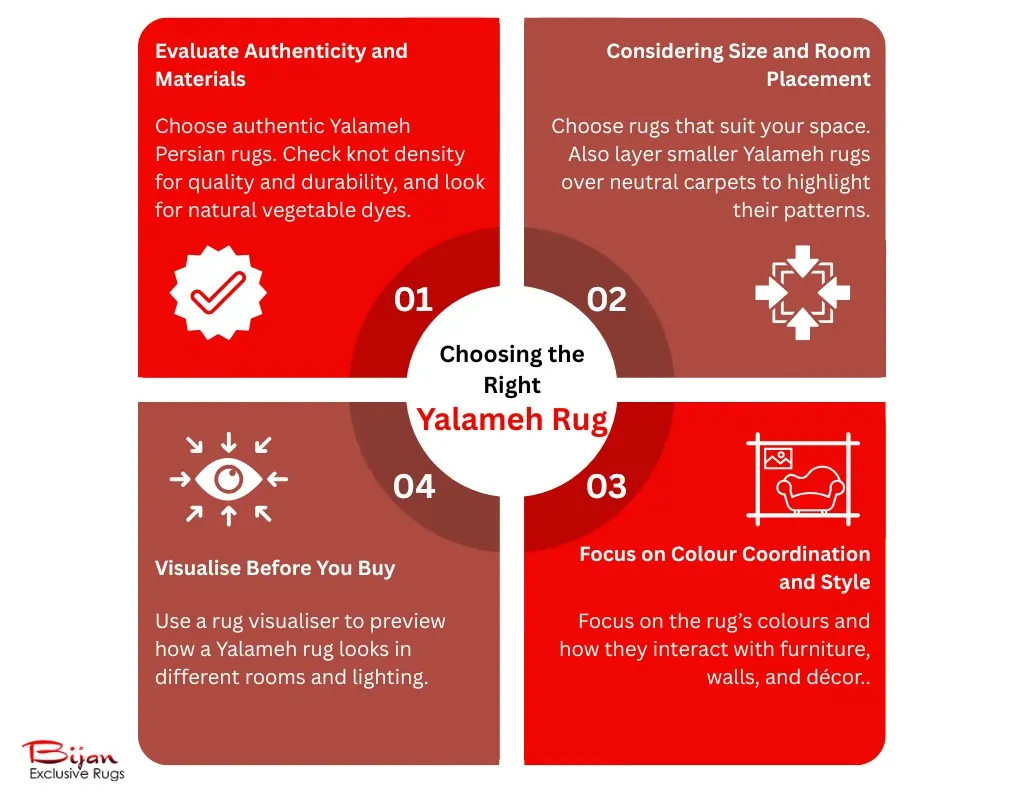
When choosing a Yalameh rug for your home, consider authenticity, materials, and design to bring beauty and cultural heritage to your space. To make the right decision, it is better to understand the history and origins of Yalameh rugs and how they will fit your interior.
Evaluating Authenticity and Materials
Look for authentic Yalameh Persian rugs that are hand-knotted and stuffed with natural fibres, such as hand-spun wool.
Check knot density: the more knots, the better the craftsmanship and durability.
Examine natural dye use: traditional vegetable-dyed rugs are fuller in colour and more balanced than synthetic ones.
Considering Size and Room Placement
Select rugs that match your space: runner rugs are great for hallways, square rugs for small spaces, and oversized rugs for large spaces.
Consider layering smaller Yalameh rugs over larger neutral carpets to add visual interest and highlight geometric motifs.
Colour Coordination and Style
Focus on the rug’s colour scheme and how it plays with furniture, wall colours, and decorative elements.
Tribal geometric patterns in Yalameh rugs can add bold focal points, while neutral tones help tie modern interiors together.
Visualising Before You Buy
A rug visualiser lets you see how a Yalameh rug would look in various room setups and under different lighting conditions.
This helps ensure the rug complements your space without ruining its original tribal look and colour vibrancy.
Bring History, Artistry, and Character Into Your Home!
The enduring appeal of Yalameh rugs lies in the balance they strike between artistry, tradition, and practicality.
When exploring the history of Yalameh rugs, it becomes clear that these textiles represent far more than decorative floor coverings.
Their bold geometric designs, vibrant natural colours, and durable hand-knotted construction reflect generations of tribal craftsmanship.
The history and origins of Yalameh rugs in the tribal communities of southwestern Iran continue to shape their character today, preserving a weaving tradition that has remained remarkably authentic.
For anyone inspired to explore the Yalameh rug origins further, discovering the right piece is an important step.
At Bijan Exclusive Rugs, we carefully curate a collection of authentic Yalameh rugs along with a wide selection of Persian and Oriental rugs that reflect centuries of weaving tradition.
Our collection is designed to help you find a rug that suits both your space and your appreciation for craftsmanship.
Explore our rug collection today and discover the Yalameh rug or Persian carpet that will bring history, artistry, and character into your home.Contact us now!