

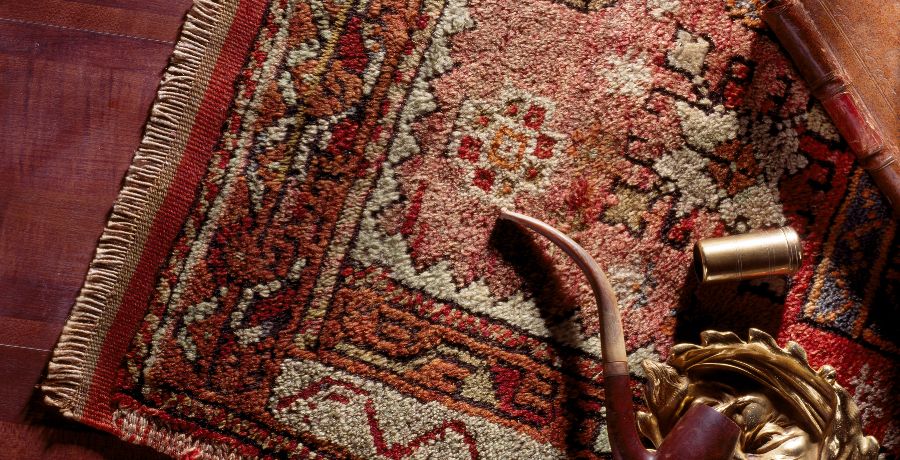
I’m often asked about the history and origin of Hereke rugs—and for good reason. These pieces are widely regarded as some of the finest woven carpets in the world.
Their reputation for silk craftsmanship, extraordinary detail, and royal heritage places them in a category of their own.
Understanding the history behind Hereke rugs adds real depth for both collectors and designers.
When you know the historical background of Hereke rugs and how Hereke rugs originated, you begin to see more than just a beautiful carpet.
In this guide, I’ll walk you through the history of Hereke rugs, the traditional craftsmanship that defines them, and why their story continues to matter today.
If you’re drawn to their luminous texture and fine detailing, you can also explore our premium silk rugs collection.
Related: History and Origin of Yalameh Rugs
The Birthplace of Hereke Rugs
When exploring the history and origin of Hereke rugs, it all starts with the quiet town on the coast of Turkey, in the north-west.
Hereke, located along the Sea of Marmara, may not be a big place, but its artistic legacy is anything but that.
It does not require one to travel far to find out where Hereke rugs are produced, which helps us better understand why they are regarded as some of the most sophisticated textiles ever woven.
The actual origin of Hereke rug weaving dates back to 1843, when Sultan Abdülmecid I of the Ottoman Empire established an imperial weaving workshop in the town.
It was one of the landmark moments in the history of Turkish Hereke rugs. The workshop was initially established to produce luxurious textiles and carpets intended only for use in Ottoman palaces.
Over time, these rugs spread their reputation far beyond the empire’s borders.
The origin story of Hereke rugs is closely connected with royal ambition. The Ottoman court did not simply desire carpets; it wanted masterpieces that would rival and surpass the best weaving available at the time.
Designers hired by the court collaborated with the best artisans, resulting in artistry so exceptional that it was exceptional.
This royal patronage was significant in establishing the legacy and origins of Hereke rugs, where stringent quality requirements were set, setting standards that still influence production today.
This attention to detail defines the history of authentic Hereke rugs and continues to distinguish them from other regional styles.
To get into similar weaving traditions and find more outstanding works, you can browse our collection of Turkish rugs.
Ottoman Influence and Royal Patronage
When we dive into the history and origins of Hereke rugs, it’s impossible to separate these masterpieces from the influence of the Ottoman Empire.
Since the very beginning of its history, Hereke rugs have been produced with one particular purpose: to decorate the rich halls of Ottoman palaces and to represent the empire’s elegant taste.
As a matter of fact, Hereke Imperial Manufacture was established in 1843 under Sultan Abdulfamwed I specifically to make luxurious carpets and textiles that the royal court would use.
They were not regular floor coverings. The historical background of Hereke rugs is highly entrenched in imperial ambitions and courtly preferences.
The most experienced court artists and master weavers throughout the empire were gathered at the workshop, where they combined traditional Anatolian styles with traces of Persian and even European designs.
Such a combination of artistic skill contributed to the Hereke rugs becoming among the most remarkable.
To view some really spectacular works of this artistic tradition, be sure to browse our curated masterpieces collection.
What Makes Hereke Rugs Exceptional
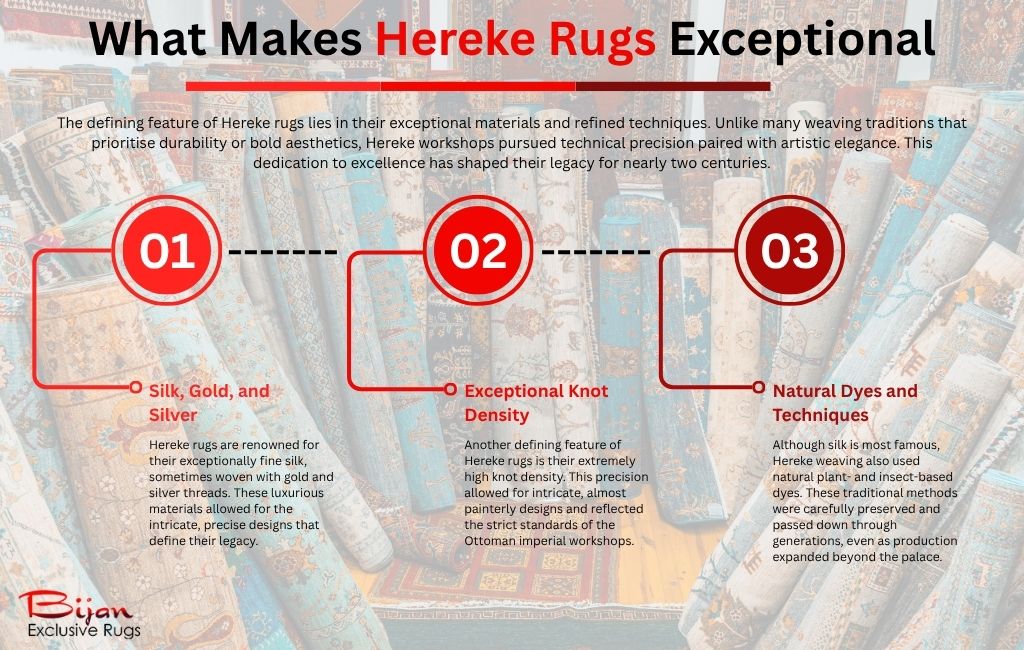
The true distinction in the history and craftsmanship of Hereke rugs lies in the materials and techniques used to create them.
While most of the rug traditions focus on durability or flashy design, Hereke workshops were much more ambitious, namely, technical perfection combined with visual refinement.
This commitment to excellence has defined the history of authentic Hereke rugs for nearly two centuries.
Silk, Gold, and Silver
A very striking fact in the history of Hereke rugs is the use of very fine silk.
Early palace commissions often used silk foundations with silk piles to create a luminous surface that subtly reflects light.
In other imperial works, gold- and silver-wrapped threads were woven directly into the design, turning the carpet into more of a royal object than merely a decorative one.
These materials were not chosen simply for opulence. They permitted unmatched accuracy, which contributed to the complex patterns that took centre stage in the tradition and origin of Hereke rugs.
Exceptional Knot Density and Precision
The extremely dense knot density is another characteristic element in the history of Hereke rug weaving. Some silk Hereke carpets can exceed one million knots per square metre.
This level of detail allows fluid floral designs, elaborate medallions and light arabesques that seem painted indeed, but not woven.
The imperial atelier maintained very high standards of quality, ensuring each artwork corresponded to the artistic vision of the Ottoman elite.
This accuracy became a trademark of Hereke rugs, setting them apart from other weaving hubs.
Natural Dyes and Time-Honoured Techniques
Although silk takes centre stage, the Hereke traditional weaving also uses some natural dyes derived from plants, roots, and insects.
These eco-friendly colourants added depth and permanence to designs and maintained the integrity of the materials.
The cultural history of Hereke rugs reveals that these methods of dyeing and weaving were diligently maintained and passed down, forming weaving traditions for a new generation of artisans.
Although the scope of production expanded beyond the palaces, traditional approaches remained rooted in tradition.
For readers interested in exploring the artistry of natural dyeing across different weaving styles, you can learn more about traditional techniques in vegetable dye rugs.
Design Motifs and Artistic Evolution
Another interesting aspect of the Hereke rug’s history and origins is the visual language conveyed in each carpet.
Hereke designs, from the earliest palace commissions to later commercial pieces, are endowed with an extraordinarily rich combination of symbolic motives, elegant style, and artistic development that makes them stand out in the realm of hand-made carpets.
Classic Ottoman Floral Patterns
The fields and borders of these rugs are covered with classic motifs such as tulips, roses and other stylised blossoms, all associated with beauty, life and harmony, which were main themes in the cultural history of Hereke rugs.
These complex floral designs were characteristic of the palace carpets that adorned palace halls and ceremonial rooms.
Medallions, Arabesques, and Palace-Inspired Layouts
The next characteristic in the evolution and origin of Hereke rugs is the application of central medallions with borders filled with arabesque and vine work.
These structural components often echo architectural ornamentation in palaces and mosques.
The designs are compatible and composed of flowing arabesques and balanced medallions—creating a visual experience that feels harmonious yet richly detailed.
These motifs became a defining feature of Hereke carpets as they matured artistically.
Transition from Court Exclusivity to Commercial Production
At first, Hereke carpets were designed specifically for the Ottoman Empire’s elite. They were luxury furnishings, and the designs were carefully made to emulate the taste in palaces.
Over time, when demand was outside the court premises, weavers resorted to modifying classical designs to suit the foreign market.
This transition became one of the significant steps in the history of Hereke rug weaving, when traditional motifs were retained and, at the same time, adjusted to broader stylistic trends without losing their sophisticated nature.
Artistic Dialogues with Persian Traditions
While Hereke rugs maintain a distinct Turkish identity, their artistic evolution also reflects a conversation with Persian design traditions.
Persian rugs, famous for their floral and medallion designs, are aesthetically similar but differ in knot methods and stylistic focus.
To deepen your understanding of these stylistic relationships, you can compare them with traditional Persian Rugs.
Hereke Rugs in the Global Context
As the history and origins of Hereke rugs continued to develop even in the late 19th century, their influence began to reach far beyond the Ottoman palaces.
What began as an imperial workshop project slowly evolved into a world-renowned weaving culture.
Understanding this international expansion is essential to appreciating the evolution and origin of Hereke rugs.
From Imperial Courts to International Markets
Towards the end of the Ottoman period, Hereke carpets ceased to be used only in royal interiors. The finely woven pieces reached Europe and other parts of the world as diplomatic and trade relations expanded worldwide.
Their fame for knot density, silk work, and exuberant design soon established them as some of the most esteemed carpets in the world.
This growth was a turning point in the history of Hereke rug weaving. As they developed further to meet the demands of international markets, attention to precision and artistry (the traditional roots of Hereke rugs) continued to form the core of the identity.
Influence on and Distinction from Other Weaving Traditions
When Hereke rugs began to be sold in the world market, it was only natural that they would be compared to other well-established weaving localities.
Despite these stylistic overlaps, the traditions have their own peculiarities and are affected by geographical, material, and cultural factors.
Below is a brief comparative overview:
- Afghan Rugs: Afghan rugs are characterised by bold geometric designs and heavy, earthy colours, and generally focus on tribal symbols and are made of wool. Hereke rugs, on the contrary, frequently feature silk bases and elaborate floral decoration.
- Pakistani Rugs: Pakistani rugs often have repeated motifs of Bokhara and tight, even knotting. They are technically sophisticated, though less complex in design than Hereke pieces, and had an imperial influence.
- Indian Rugs: Indian rugs have always been influenced by Persian and Mughal designs. Although Hereke designs share floral influences with other rugs, the cultural history of the Hereke rugs is firmly tied to Ottoman court art and silkwork.
A Distinct Identity in a Shared Craft World
Although Hereke rugs are compared in different parts of the world, their background and legacy still retain a distinct Turkish touch and a strong sense of imperial favour.
Their combination of silk materials, medallion-like structure, and incredible density of knots remains a feature that sets them apart in the broader tapestry of the world-weaving tradition.
Hereke rugs are not another local style within the wider global system, but an elegant combination of courtly visions, technical perfection, and transnational experience that has established them among the most popular carpets of all time.
Hereke Rugs in Modern Interiors
Although the history and origin of Hereke rugs can be traced back to imperial palace workshops, their popularity has not remained confined to museums and conventional households.
Nowadays, these luxurious rugs are often used by interior designers and homeowners in modern settings, proving that classical craftsmanship can be as modern when it is well-decorated.
Traditional Luxury in Contemporary Homes
Hereke rugs bridge the gap between ancient world art and the new world. Their textures and the thoroughly elaborated patterns add some warmth and character to minimalist, mid-century, or eclectic interiors alike.
Although the heritage and origins of Hereke rugs are historic, the functionality of the pieces in a room is thoroughly modern, making the floors the aesthetic centrepiece.
The literature on floor placement in interior design notes that traditional carpets can provide a grounding element in a contemporary living room without taking up much space.
To explore contemporary interpretations of classic floor coverings that pair beautifully with Hereke pieces, check out our selection of modern rugs.
Styling Large Palace-Size Rugs
Palatial proportions are no longer confined to great hallways. Hereke rugs in oversized sizes are a great option for open-plan living rooms, formal dining rooms, or master suites.
Their scale allows for room elements to be grounded while emphasising complicated designs and bright colours.
If dramatic scale is something you’re considering for your design scheme, our oversized rugs can serve as an excellent visual point of reference for how large formats can uplift space.
Adapting to Urban and Smaller Spaces
Not all contemporary living rooms are spacious in size—and that’s where the adaptability of Hereke rugs comes in.
Smaller format options, such as square or runner designs, are very effective in apartments, entryways, bedrooms, and transitional rooms.
These dimensions allow you to experience the lavish feel and historical richness of Hereke weaving without filling a small room.
- For living rooms or seating areas, square rugs offer balance and symmetry.
- In corridors or narrow halls, runner rugs bring elegance underfoot.
- For vibrant urban living, city rugs adapt traditional motifs to contemporary layouts.
Classic Meets Contemporary
Placing Hereke rugs in the modern interior is not only about positioning but also about creating contrast.
A combination of these historically rich carpets with smooth furniture, neutral palettes, or industrial accents creates a curated look that is both modern and classic.
The Hereke rug weaving history reminds us that good design has no time limit, and modern-day homes are all the better for incorporating tradition and innovation.
The Enduring Prestige of Hereke Rugs
As we’ve explored throughout this guide, the history and origin of Hereke rugs are deeply rooted in royal ambition and artistic mastery.
What makes them truly enduring is not just their silk foundations or intricate knotting—it’s the story woven into every piece.
The history and craftsmanship of Hereke rugs reflect generations of discipline, creativity, and courtly influence.
As someone who works closely with Oriental and Persian rugs in Sydney, I always encourage clients to explore authentic weaving traditions beyond a single region.
While Hereke rugs represent the pinnacle of Ottoman artistry, discovering other regional styles can open up new design possibilities and perspectives.
At Bijan Exclusive Rugs, we help you find more than just a rug—we help you find the right rug.
Whether you’re drawn to the refinement of Hereke silk pieces or looking to explore different global traditions, we offer carefully curated collections that span classic, antique, contemporary, and investment-worthy designs.
If you’re ready to elevate your space with a piece that carries history, craftsmanship, and timeless appeal, visit our showroom or browse our collections today.
Let us guide you toward a rug that truly belongs in your home. Contact us now!