

When people visit us at Bijan Exclusive Rugs and ask, “What materials are Persian rugs made of?” I know they are usually trying to understand what gives these rugs their beauty, texture, value, and longevity.
The answer is not just one thing. The most common Persian rug materials include wool, silk and cotton, with some rugs also featuring natural or vegetable dyes that add depth and character to the design.
In this guide, I’ll walk through the main materials used in Persian rugs, including wool Persian rugs, silk Persian rugs, and the role of a cotton foundation in Persian rugs.
I’ll also explain how these traditional Persian rug materials affect softness, durability, sheen, colour depth and overall feel.
For Australian homes, this matters more than many people realise. Whether your rug is going in a living room, bedroom, dining area, hallway or open-plan space, understanding Persian carpet materials can help you choose Persian Rugs that suit both your lifestyle and interior style.
Why Rug Material Matters
The material tells you more than just what the rug is made from. It tells you how the rug will feel, how it will age, how it will hold colour, and whether it is suited to a busy Australian home.
This is one of the first things I check to help someone select an authentic Persian rug. Wool, silk, and cotton are the most common materials for Persian rugs.
Many Persian rugs made of wool are adored because wool is warm and comfortable to walk on, and it’s naturally durable for homes. Wool also holds dye so well, which is why Persian rugs are known for their rich colour and pattern definition.
Silk and wool Persian rugs often have a finer sheen and more detail, while a cotton foundation Persian rug may lend more stability and detail.
Historical carpets in the Metropolitan Museum of Art are documented in wool, cotton, and silk in the warp, weft, and pile, highlighting the significance of these fibres in the making of traditional carpets.
The material best suited for Persian rugs depends on where the rug will be placed. That is why handmade Persian rug materials are important: they shape comfort, durability, colour, texture, collectability, and long-lasting beauty.
What Materials are Persian Rugs Made of: Wool
Wool is the first material that comes to my mind when people ask me what Persian rugs are made of. Wool is the heart of many of the traditional Persian rugs and is responsible for that beautiful balance of softness, strength, warmth, and everyday practicality.
The reason wool is so popular is simple: it performs well.
A good wool pile is supple to the touch but has enough resilience to withstand heavy use. That makes wool Persian rugs a good option for Australian homes, particularly in lounge rooms, bedrooms, dining rooms, and family spaces.
Wool is not created equal, however. A coarse wool may not produce the same luxury finish as a finer, high-grade wool. When looking at handmade Persian rugs, always pay attention to the handle of the wool, the pile density, and the clarity of the design.
Wool is also a great fibre for colouring. Victoria and Albert’s Museum reports that the famous Ardabil Carpet’s wool pile retains more dye than silk, allowing for rich colour and intricate detail. That is why wool is still a significant component of traditional Persian rug materials.
Wool is also really versatile. It can be used in older heritage homes with timber floors, or incorporated into a modern, open-plan environment to add warmth and texture.
It is also a very long-lasting Persian rug option that is a favourite choice for busy households, particularly compared to silk rugs.
What Materials are Persian Rugs Made of: Silk
Silk is always one of the fibres people are curious about. And honestly, I understand why. Silk has that shiny, bright look that gives any rug a more refined appearance.
Wool is often the practical beauty, while silk is the showpiece.
Silk is prized in Persian rug weaving because it can create:
- a soft, almost glowing sheen
- very fine pattern detail
- a smoother feel underhand
- sharper floral, medallion and border designs
- a more delicate, decorative finish
According to the Met, the historic Silk Kashan Carpet is made of an “entirely silk construction,” and its pattern is created by extremely dense, tiny hand-tied silk knots.
One reason for the detail seen in the finest Persian silk rugs is the use of fine threads. The finer and smaller the fibre, the more complex the design can be. Another noteworthy carpet in the Met is a 16th-century Iranian silk carpet, one of the finest of its time, with approximately 800 knots per square inch.
For Australian homes, I usually recommend silk for quieter spaces, such as:
- formal sitting rooms
- bedrooms
- decorative areas
- low-traffic spaces
- wall display pieces
I would be more cautious if using silk in the entry hall, dining room or home with pets and young children. In terms of durability, wool is typically the better choice for everyday use.
What Materials are Persian Rugs Made of: Cotton
Even if a rug is said to be a wool rug, it could be a cotton foundation Persian rug. For instance, the Met keeps several carpets from Iran that have cotton for the warp and weft and wool for the pile.
- Warp means the vertical threads running through the rug.
- Weft means the horizontal threads woven across the warp.
- Pile means the soft surface you see and walk on.
Cotton is used in many Persian carpets for the warp and weft because it provides the rug with shape, stability, and structure. The pile is typically made of wool or silk and is used for texture, softness, and design.
Cotton also aids in finer weaving. Once the foundation is secure, the weaver can create more intricate patterns and exercise greater control. The foundation’s importance to the rug’s overall structure is illustrated by the fact that Persian carpets are generally knotted in pairs of warps, as explained in Encyclopaedia Iranica.
Cotton foundations are a definite benefit for Australian homes – particularly for rugs in dining rooms, bedrooms, and living rooms. They can aid in proper rug positioning, maintain its form, and preserve its design balance over time.
Wool on Cotton, Wool on Wool, and Silk on Silk: What These Terms Mean
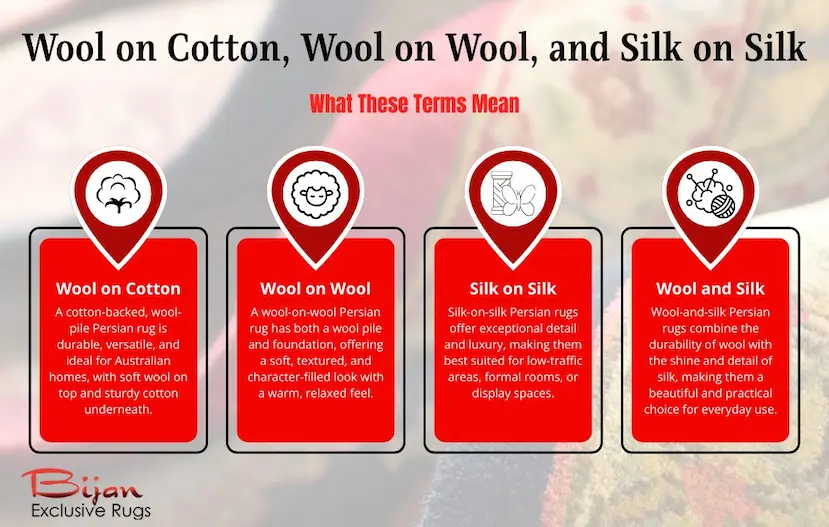
In real rug language, you will often hear terms like wool on cotton, wool on wool, or silk on silk. The first material usually refers to the pile, and the second refers to the foundation.
Wool on Cotton
This indicates that the rug is made with a cotton backing and a wool pile. In layman’s terms, wool is what you see and walk on, and cotton gives the rug structure underneath.
One of the most popular and useful Persian rug materials is this. It’s versatile, long-lasting, and makes for a great addition to any home in Australia.
The Met presents historic Iranian carpets with cotton foundations and woollen piles, reflecting the long history of carpet weaving and the use of this construction.
Wool on Wool
This means both the pile and foundation are wool. I often associate this with village or tribal-style rugs. It can feel a little more relaxed, earthy, and flexible than a cotton-foundation Persian rug.
Wool-on-wool may be a great option for those who prefer texture and character. It may not be as tightly spun as wool-on-cotton, but it has warmth and personality.
Silk on Silk
This is when it gets tricky and sophisticated. Silk Persian rugs can be woven with silk pile, warp and weft. For instance, the Met’s Silk Kashan Carpet is made in silk warp, weft, and pile, with an asymmetrically knotted pile.
Silk-on-silk rugs can capture a lot of detail but are typically better suited to low-traffic areas, formal rooms, or display spaces.
Wool and Silk Persian rugs
They’re usually my favourite middle ground. The addition of wool enhances the rug’s body and durability, while silk highlights enhance its shimmer and pattern definition.
Always ask yourself where the rug will go. Wool is generally stronger when worn daily.
For true statement pieces, many collectors look toward Masterpieces because the materials, weaving and artistry all come together.
Which Persian Rug Material Is Best for Australian Homes?
So which material should I select for my house?”
Always bring it back to lifestyle first.
Australian houses can get busy. Open-plan living, indoor and outdoor movement, children, pets, entertaining, bright windows, and lots of high-traffic areas. So the best material will vary depending on where the rug is meant to be placed.
For Everyday Living: wool
When I’m looking at rugs for living rooms, family rooms or dining spaces, I tend to go with wool Persian rugs. Wool has a warm, comfortable feel and is also practical for everyday use.
When I’m asked what the most durable material for a Persian rug is, wool is usually the answer.
For Quiet Luxury: Silk
Silk Persian rugs are beautiful, but treat them differently. They are better suited to:
- formal rooms
- bedrooms
- low-traffic spaces
- decorative areas
- wall display
The Met notes that especially fine carpets were historically considered too precious for the floor and were sometimes used on furniture or hung on walls.
For Balance: Wool with Silk Highlights
Wool-and-silk Persian rugs can be a lovely middle ground for those who want something both beautiful and functional. Wool adds body and strength, and silk adds shimmer and sharpness.
For Structure: Cotton foundations
If you need stability, a cotton foundation Persian rug can be a great idea. Cotton warp, weft, and wool pile are common constructions used in traditional rug-making in Iran, as documented in the Met records.
Runner rugs made of wool or wool-cotton may be a better choice in hallways, as they handle foot traffic more readily than delicate silk rugs. In open-plan rooms, oversized wool rugs can help tie the room together and provide a warm underfoot feel.
Also, always be aware of strong direct sunlight. If the room has a large Australian window, rotate the rug where possible, as light can alter colours over time.
Do Materials Affect the Value of a Persian Rug?
Yes, materials do influence value, but they are just one factor. A beautiful fibre is important, but the whole rug must make sense.
Why Silk Can Be More Valuable
Silk Persian rugs can also be more expensive, as silk allows for extremely fine detail and a lustrous finish.
This is a part of the reason silk Persian rugs are priced high. It’s not just the silk. It is also the labour, precision, and detail that are involved.
Why Wool Can Still Be Valuable
Good Persian wool rugs can also be very valuable, particularly if the wool is fine, the weaving is good, and the design is strong.
Other Things That Influence Value
When I assess what makes Persian rugs valuable, I usually look at:
- material quality
- natural or vegetable dyes
- age and origin
- knot density
- design clarity
- condition
- repair history
- overall craftsmanship
Vegetable dyes can add beautiful depth and individuality. Encyclopaedia Iranica notes that vegetable dyes remained in common use in Persian carpet weaving until the 1940s.
Condition Matters Too
Although older antique rugs can have greater value as collectibles, condition is an important factor. Value can be impacted by wear, fading, weak foundations, stains, and/or poor repairs.
That is why a professional rug valuation is useful for older, silk or finely woven rugs. Persian rug materials matter most when they are supported by skilled weaving, beauty, history, and proper care.
Final Thoughts: Choosing a Persian Rug by Material
When it comes to the materials Persian rugs are made of, the main materials to understand are wool, silk, cotton foundations, and natural dyes. Each one plays a different role in the rug’s beauty, comfort, durability and long-term value.
For most Australian homes, I usually see wool as the most practical choice. It is warm, durable and well-suited to everyday living areas, family rooms, bedrooms and dining spaces.
Silk, on the other hand, offers a rare level of refinement, sheen and fine detail, making it better suited to quieter rooms, decorative spaces or collectors looking for something truly special.
At Bijan Exclusive Rugs, we can help you compare different Persian rug materials in person. Our rug collections include pieces suited to busy homes, formal interiors and statement spaces, so you can choose with confidence rather than guess.
Before buying, consider where the rug will sit, how much foot traffic it will receive, and whether you want something practical, decorative, collectible, or heirloom-worthy.
Explore our rug collections or browse our latest rug sale to find a Persian rug that feels right for your home.